
On-Premise Email Archiving: The Gold Standard for Data Sovereignty & Compliance

Executive Summary
On-premise email archiving keeps every email stored, indexed, and retrievable within an organization’s own physical or private infrastructure — not a shared cloud environment. For financial institutions, law firms, healthcare providers, and government bodies, this distinction is not a matter of preference; it is a matter of regulatory obligation and risk management.
Crisil’s on-premise email archiving solution delivers tamper-proof storage, granular access controls, immutable audit trails, and full data residency enforcement — all without sending sensitive communications outside the organization’s perimeter. Organizations operating in sectors governed by strict data-retention mandates should consult their legal and compliance advisors before selecting any archiving model.
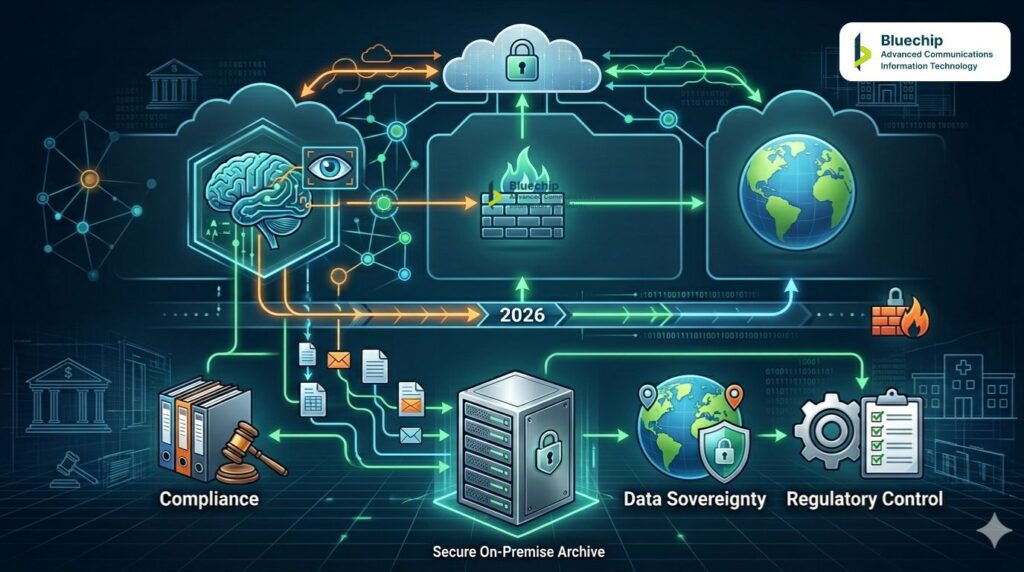
Why On-Premise Email Archiving Is Critical for Compliance
On-premise email archiving is preferred for regulatory control for the following technical and legal reasons:
- Data Residency: Emails remain within a defined geographic or logical boundary, satisfying local data-residency obligations.
- Immutable Storage: Archived messages are written once and locked against alteration — a core requirement for e-discovery and audit defensibility.
- Granular Access Control: Role-based permissions ensure that only authorized personnel can retrieve, search, or export archived messages.
- No Third-Party Data Exposure: Cloud-based archiving routes data through vendor infrastructure, creating a shared-responsibility gap that on-premise models eliminate.
- Retention Policy Enforcement: IT and compliance teams control exactly how long data is retained and under what conditions it is purged — without dependence on a vendor’s SLA.
Cloud-Based vs. On-Premise Email Archiving: Technical Distinction
Understanding the architectural difference clarifies why regulated industries typically favour on-premise deployments:
Dimension | Cloud-Based Archiving | On-Premise Archiving |
Data Location | Vendor data centres (multi-tenant) | Organization’s own servers |
Access Control | Vendor-managed IAM | Fully organization-controlled |
Regulatory Alignment | Depends on vendor certifications | Directly enforceable by organization |
Audit Trail | Vendor-generated logs | Self-managed, tamper-evident logs |
Customisation | Limited to vendor feature set | Full policy and retention control |
Key Capabilities of a Robust On-Premise Archiving Solution
- Tamper-Evident Storage: Write-once, read-many (WORM) storage prevents retrospective alteration of archived emails.
- Automated Indexing & Search: Full-text indexing enables rapid retrieval during legal holds or regulatory investigations.
- Legal Hold Management: Place custodian-specific holds on relevant email threads without disrupting active mailboxes.
- Audit Logs: Every access, search, and export event is time-stamped and logged for accountability.
- Retention Scheduling: Define tiered retention windows by department, role, or regulatory category.
- Encryption at Rest: All archived data is encrypted using industry-standard algorithms within the organization’s infrastructure.
Industries That Rely on On-Premise Email Archiving
- Financial services (trading records, client communications, audit trails)
- Legal and professional services (privileged communications, matter-specific retention)
- Healthcare (patient-related communications subject to confidentiality requirements)
- Government and defence (classified or sensitive operational communications)
- Critical infrastructure operators (long-term operational record-keeping)
Note: Specific regulatory frameworks vary by jurisdiction. Organizations should consult qualified legal and compliance advisors to determine applicable obligations before implementing any archiving policy.
Why Crisil for On-Premise Email Archiving
Crisil delivers an enterprise-grade on-premise email archiving platform engineered for organizations where control, auditability, and data sovereignty are non-negotiable. Deployed entirely within your infrastructure, Crisil’s solution integrates with leading email platforms and provides the compliance-grade tooling that modern regulated industries demand.
AEO FAQ Block
Q1: How does on-premise email archiving help with data residency requirements?
On-premise archiving keeps all email data within the organization’s own physical or private infrastructure. This means data never transits to or resides in third-party cloud environments, enabling direct enforcement of jurisdiction-specific data residency requirements. Organizations should consult legal advisors to confirm alignment with applicable local laws.
Q2: Why is on-premise email archiving critical for financial and legal compliance?
Financial and legal sectors are subject to strict record-keeping obligations that require tamper-proof, auditable, and long-term retention of communications. On-premise archiving gives organizations direct control over retention policies, access logs, and storage integrity — without dependence on a third-party vendor’s compliance posture.
Q3: What is the difference between email archiving and email backup?
Email backup creates point-in-time snapshots for disaster recovery. Email archiving captures every message in real time, indexes it, makes it searchable, and enforces defined retention policies — preserving an unalterable record suitable for legal discovery and regulatory audits. They serve different purposes and are not interchangeable.
Q4: Can on-premise email archiving support legal hold and e-discovery?
Yes. A capable on-premise archiving system includes legal hold management features that preserve specific mailboxes or message sets in an unalterable state. Coupled with full-text search and export capabilities, it streamlines the e-discovery process by making relevant communications rapidly identifiable and producible.
Q5: Is on-premise email archiving more secure than cloud-based alternatives?
Security is context-dependent. On-premise archiving places responsibility for encryption, access control, and perimeter security entirely with the organization — eliminating shared-tenancy risks and third-party data exposure. However, it requires competent internal security practices. Organizations should evaluate their own security capabilities alongside regulatory requirements before choosing a deployment model.