
Optimising IAM Solutions in KSA: Why Identity and Access Management Is the Backbone of Saudi Enterprise Cybersecurity

Table of Contents
Introduction: The Access Problem That Most Enterprises Are Carrying Without Knowing It
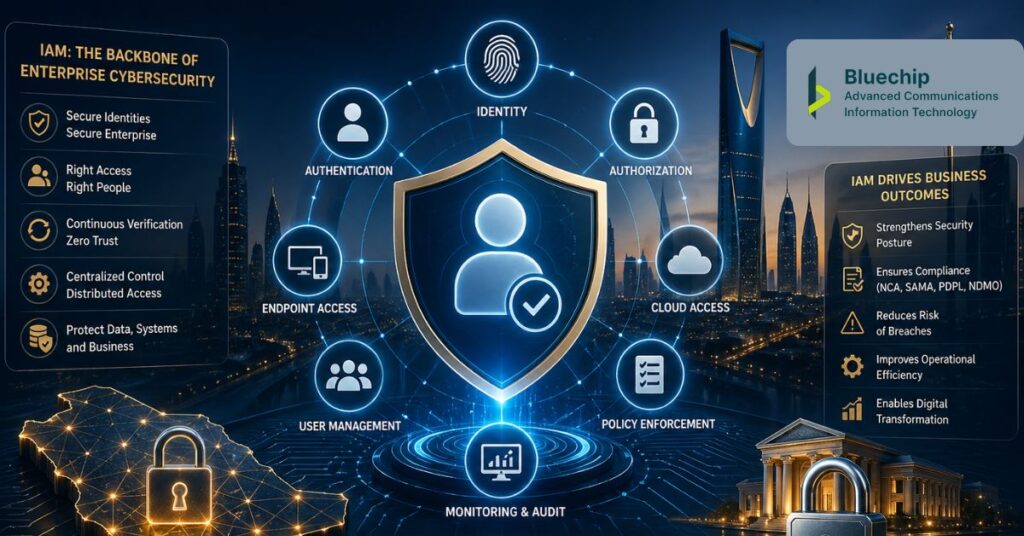
In the meeting of Identity and Access Management KSA,
If you asked your IT team to produce, right now, a complete list of every user who has access to every system in your organisation — and to confirm that each access right is still appropriate — how long would it take? For the vast majority of Saudi enterprises, the answer may too long. For some, the answer may we could not do it accurately at all.
This is the identity access problem. It is not a gap that exists because organisations are negligent. It accumulates because user access rights are easy to grant, rarely reviewed, and difficult to revoke systematically. An employee changes roles — their old access rights remain. A project ends — the contractor’s account persists. A department restructures — the permissions that were assigned to a previous function carry forward untouched.
Over time, what accumulates is an organisation where the gap between who should have access and who actually has access is substantial — and largely invisible. Identity and Access Management (IAM) exists to close that gap: to make access rights visible, to enforce the principle of least privilege, and to ensure that access governance is a managed, auditable process rather than an inherited accumulation of historical decisions.
The information in this article is provided for general guidance and reflects common technical practices in enterprise IT security. BlueChip Saudi makes no claims regarding governmental, regional, or regulatory compliance on behalf of any client. All implementation decisions should be assessed by qualified professionals. For formal regulatory and legal guidance, consult a reputed government-approved adviser in your sector and jurisdiction. |
The Four Pillars of Enterprise IAM
1. Identity Governance and Administration (IGA)
Identity Governance is the discipline of defining who should have access to what, enforcing that definition, and certifying it regularly. In practice, this means maintaining an authoritative identity source — typically integrated with your HR system — and ensuring that access rights across all enterprise systems reflect the current role and status of each user. When an employee joins, they receive the access their role requires. When they leave, that access is revoked immediately and completely. When they change roles, access is adjusted to match the new role — and previous access rights are removed.
2. Privileged Access Management (PAM)
Privileged accounts — system administrators, database administrators, and service accounts with elevated permissions — represent the highest-value targets in any enterprise environment. Privileged Access Management focuses specifically on these accounts: enforcing just-in-time access (temporary, time-limited elevation for specific tasks), recording privileged sessions for audit purposes, rotating credentials automatically, and ensuring that permanent standing privilege is eliminated wherever operationally feasible.
3. Access Certification and Entitlement Reviews
Access rights that are not regularly reviewed accumulate. Users who have moved between departments retain access to systems from previous roles. Project-based access granted for specific initiatives is never revoked. Over time, the difference between what users need and what they have becomes operationally dangerous. Access certification is the formal process of reviewing, confirming, and revoking access rights on a defined schedule — ensuring that the access estate reflects current organisational reality rather than historical decisions.
4. Lifecycle Management and Automated Provisioning
The IAM lifecycle encompasses the full journey of an identity within an organisation: joiner (onboarding a new employee with role-appropriate access), mover (adjusting access when an employee changes role, location, or function), and leaver (revoking all access when an employee departs). Automating this lifecycle — through integration between the HR system, the IAM platform, and downstream applications — removes the manual error points that most organisations rely on today and ensures that access changes happen consistently, completely, and with a documented audit trail.
Why SailPoint Expertise Matters for Complex Saudi Enterprises
BlueChip Saudi’s IAM practice includes deep expertise with SailPoint’s Identity Security platform — one of the most capable and widely deployed enterprise IAM solutions globally, particularly well-suited to organisations with complex, multi-system access environments.
SailPoint’s strength lies in its ability to handle identity governance at scale: across hundreds of applications, thousands of users, and complex role hierarchies that reflect the operational realities of large enterprises and diversified organisations. Its AI-driven access recommendations and automated certification workflows address two of the most persistent challenges in enterprise IAM — the effort required to conduct meaningful access reviews, and the quality of decisions made during those reviews.
Our SailPoint practice focuses on the outcomes that the platform enables — a governed, auditable, and operationally manageable identity environment — rather than on feature-level deployment. We integrate SailPoint with the systems that matter most to your organisation: HR, Active Directory, cloud applications, and on-premise systems — creating a unified identity fabric that reflects and enforces your access policies across your entire enterprise footprint.
SailPoint is one of several enterprise IAM platforms in our practice. We evaluate each engagement against the full landscape of available solutions and recommend based on your specific requirements, existing infrastructure, and organisational scale.
Connecting IAM to Saudi Arabia’s Digital Transformation Agenda
Saudi Arabia’s ambition to become a leading digital economy creates a direct and growing need for mature identity security infrastructure. As organisations in the Kingdom accelerate cloud adoption, digitise government services, expand remote working programmes, and integrate third-party technology partnerships — the volume, complexity, and sensitivity of identities that must be managed is growing significantly.
IAM is the control framework that makes this digital expansion operationally safe. Without it, growth in digital capability outpaces the governance structures needed to manage access to that capability securely. The organisations that build a mature IAM foundation now will be better positioned to scale their digital capabilities confidently, knowing that access governance will scale with them.
This is not a compliance argument — it is an operational one. The value of IAM is not primarily in meeting external requirements. It is in maintaining control over your most sensitive systems as your organisation grows and your technology environment becomes more complex. (For formal guidance on any compliance obligations applicable to your sector, consult a qualified regulatory adviser.)
Conclusion: Access Governance Is a Strategic Capability
Identity and Access Management is one of the few security investments that delivers both risk reduction and operational efficiency simultaneously. It reduces risk by eliminating unnecessary access and ensuring that privileged accounts are tightly controlled. It delivers efficiency by automating the manual workflows — provisioning, deprovisioning, access review — that consume significant IT resources in organisations managing access manually.
BlueChip Saudi’s IAM practice is structured around helping organisations move from the reactive, manual access management model that most currently operate to a governed, automated, and auditable identity environment. The starting point is an identity assessment — mapping your current access estate, identifying the highest-risk gaps, and designing a prioritised remediation roadmap.