
Cybersecurity Training in Saudi Arabia: How Simulation Platforms Reduce Human Error

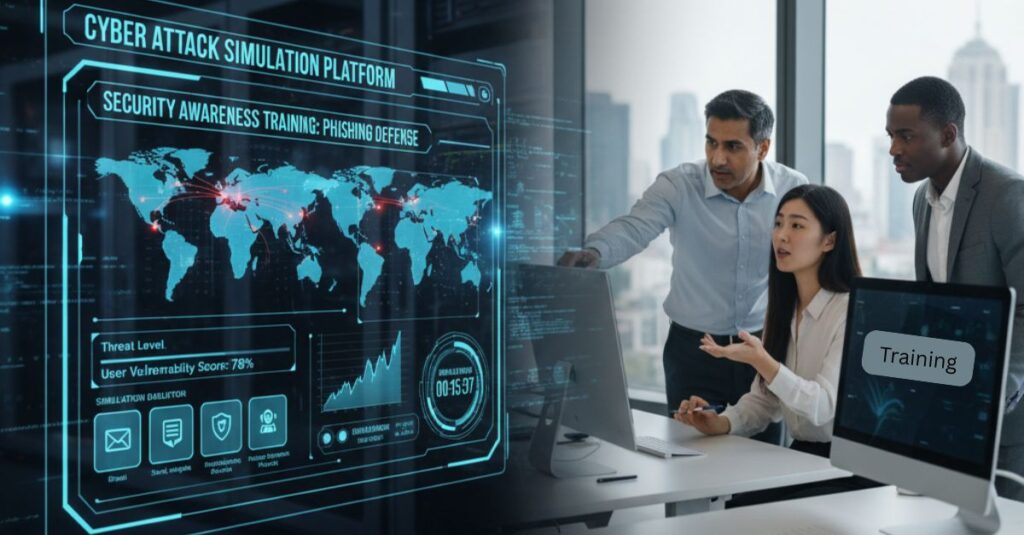
Cybersecurity Training: Building a Fortress of Human Defense in Saudi Arabia
Introduction
Your IT infrastructure might be bulletproof. Your networks locked down. Your firewalls state-of-the-art. But there’s one vulnerability that keeps Saudi security leaders awake at night: human error.
According to industry reports, 85% of breaches involve human interaction. A phishing email, a weak password, an employee clicking a malicious link—these simple mistakes can cost organizations millions in damages and irreversible reputation harm.
This is where cybersecurity training becomes your most valuable investment. Not as a compliance checkbox, but as a strategic defense mechanism that transforms your employees from your biggest security risk into your strongest line of defense.
In this comprehensive guide, we explore why cybersecurity training in Saudi Arabia is critical, how modern cybersecurity simulation platforms work, and why organizations across KSA are prioritizing employee security awareness.
The Human Factor in Cybersecurity: Why Training Matters
The Uncomfortable Truth About Cyber Attacks
When we think of cybersecurity threats, we often imagine sophisticated hackers breaking through firewalls or exploiting zero-day vulnerabilities. The reality is far simpler and more humbling:
Most breaches start with an employee.
Consider these scenarios:
- An HR manager receives an email that looks like it’s from the CEO requesting urgent fund transfers
- A finance employee downloads a “company update” that’s actually malware
- A team member uses the same password for their work email and their Netflix account
- A developer accidentally commits sensitive credentials to GitHub
- An employee connects their personal laptop to the office WiFi without security awareness
These aren’t sophisticated attacks. They’re basic social engineering that exploits human psychology and lack of awareness. Yet they’re devastatingly effective.
The Cost of Inaction
According to cybersecurity research, organizations that don’t invest in employee training experience:
3x higher breach frequency compared to organizations with strong security awareness programs
$4.5+ million average cost per breach (with human error accounting for a significant portion)
52% longer detection time for security incidents when employees aren’t trained to spot suspicious activity
Regulatory penalties and fines for failing to meet NCA (National Cybersecurity Authority) training requirements
Loss of customer trust and business relationships following security incidents
In Saudi Arabia specifically, where regulatory compliance is increasingly strict, inadequate cybersecurity training isn’t just a technical problem—it’s a business liability.
Understanding Cybersecurity Training for Modern Organizations
What Is Cybersecurity Training?
Cybersecurity training encompasses education programs designed to help employees:
- ✅Recognize security threats and attack methods
- ✅Understand their role in organizational security
- ✅Follow security policies and best practices
- ✅Respond appropriately when incidents occur
- ✅Build security consciousness into daily work habits
But modern cybersecurity training goes far beyond boring PowerPoint presentations. Today’s leading organizations use cybersecurity simulation platforms to create realistic, engaging learning experiences.
The Evolution of Cybersecurity Awareness
Traditional Approach (Outdated):
- Annual security training video
- Generic policy documents
- Fear-based messaging
- Compliance checkbox mentality
- No measurement of actual behavior change
Modern Approach (Industry Best Practice):
- Continuous, role-based training
- Realistic simulations and phishing tests
- Interactive scenarios reflecting actual threats
- Gamification and engagement mechanics
- Real-time metrics and behavior analytics
- Regular updates based on emerging threats
Saudi organizations are increasingly shifting from traditional to modern approaches, recognizing that cybersecurity training effectiveness directly correlates with organizational resilience.
How Cybersecurity Simulation Platforms Transform Security Awareness
What Are Cybersecurity Simulation Platforms?
A cybersecurity simulation platform is an advanced training tool that creates realistic cyber attack simulations in a safe, controlled environment. Employees practice responding to threats without risking actual systems or data.
Think of it like flight simulator training for pilots—except for security professionals and everyday employees. Instead of learning about phishing attacks, employees actually experience simulated phishing campaigns and learn from mistakes without consequences.
Key Features of Modern Cybersecurity Training Platforms
1. Realistic Phishing Simulations
The platform sends employees simulated phishing emails that mimic real-world attacks. When employees click suspicious links or enter credentials, they’re redirected to training rather than compromised systems. This creates immediate, memorable learning moments.
Benefits:
- Employees learn to recognize phishing patterns
- Organizations identify vulnerable populations needing additional training
- Click rates typically drop 70% after multiple simulations
- Awareness becomes habitual rather than theoretical
2. Interactive Scenario-Based Learning
Rather than passive video watching, employees engage in branching scenarios where their choices have consequences. For example:
Scenario: An employee receives a USB drive in the parking lot labeled “Salary Reviews 2026.” What do they do?
Different choices lead to different outcomes, teaching critical thinking about security risks.
3. Role-Specific Training Paths
Not all employees face the same threats. A platform with good customization offers:
IT Staff Training
Advanced technical security concepts
Finance Department Training
Fraud prevention and wire transfer verification
Executive Training
Social engineering and business email compromise (BEC) tactics
General Employee Training
Foundational security awareness
4. Real-Time Performance Analytics
Security leaders gain visibility into:
- Employee vulnerability scores
- Department-level security posture
- Click rates and phishing susceptibility trends
- Training completion and engagement metrics
- Risk assessment by role or location
This data-driven approach identifies exactly where to focus resources.
5. Continuous Threat Updates
The threat landscape evolves daily. Top-tier platforms automatically update simulations to reflect:
- Emerging attack patterns
- New malware delivery methods
- Social engineering tactics
- Industry-specific threats
- Regional threat intelligence (particularly important in Saudi Arabia)
6. Compliance Reporting
For organizations required to meet NCA cybersecurity controls and international standards, platforms provide:
- Automated compliance reports
- Training completion documentation
- Assessment records
- Incident response drill results
- Executive dashboards for board reporting
Why Saudi Organizations Are Investing in Cybersecurity Training
Vision 2030 and Security Mandates
Saudi Arabia’s Vision 2030 has accelerated digital transformation across all sectors. This rapid digitalization creates both opportunities and security challenges.
Government Requirements:
The National Cybersecurity Authority (NCA) has established Essential Cybersecurity Controls that include specific training requirements for organizations:
- ✅Annual cybersecurity awareness training
- ✅Role-specific technical training
- ✅Incident response simulation exercises
- ✅Documentation and compliance proof
Organizations failing to meet these requirements face:
- Regulatory fines
- Loss of government contracts
- Mandatory remediation programs
- Reputational damage
Industry-Specific Drivers
Financial Services
SAMA (Saudi Arabian Monetary Authority) regulations require robust employee training. Banks and fintech companies face increasing targeted attacks. Employee error in fund transfers costs millions annually.
Healthcare
SEHA (Saudi Health Council) mandates security training. Patient data breaches violate privacy laws and ethics. Ransomware targeting hospitals is rampant globally.
Government & Defense
Highly sensitive data requires cleared, trained personnel. Supply chain attacks target employees with access to classified systems. Training is non-negotiable for government contractors.
Oil & Energy
Critical infrastructure requires defense-in-depth security posture. Nation-state actors target Saudi energy sector. Employee vigilance prevents catastrophic incidents.
Retail & E-commerce
Customer payment card data requires PCI-DSS compliance training. Employees are front-line defense against fraud. Brand reputation depends on security trustworthiness.
The Business Case for Cybersecurity Training Investment
Direct Financial Benefits
1. Reduced Incident Costs
Organizations with strong cybersecurity training experience:
- 25% fewer security incidents annually
- 40% faster incident detection
- 35% reduced breach impact
- Estimated savings: $500K – $2M+ per prevented major incident
2. Compliance Efficiency
Structured training programs streamline:
- Regulatory audits and assessments
- NCA compliance demonstrations
- Insurance requirements
- Industry certifications
Compliance ROI: Organizations recover training investment through reduced audit costs and eliminated fines.
3. Reduced Operational Friction
Well-trained employees:
- Don’t get locked out by security policies
- Know proper escalation procedures
- Report incidents promptly rather than hiding them
- Support new security implementations smoothly
4. Employee Productivity
Contrary to assumptions, security training improves productivity:
- Fewer security incidents disrupting operations
- Clearer security decision-making guidance
- Reduced time spent on security incident investigations
- More confident employee behavior
Intangible but Valuable Benefits
Brand & Reputation Protection
A single major breach costs $4.5M+ and damages customer trust for years. Training helps prevent this.
Customer Confidence
B2B customers increasingly ask about security training as part of due diligence. It becomes a competitive advantage.
Employee Recruitment & Retention
Security-conscious employees want to work for organizations that invest in protection. Training sends this signal.
Organizational Resilience
Beyond financial metrics, trained employees enable organizations to recover faster from incidents and maintain business continuity.
Implementing Cybersecurity Training: A Practical Framework
Step 1: Assess Current State
Before implementing training, understand:
Current Vulnerabilities:
- Run a phishing test to establish baseline click rates
- Survey employees on security knowledge
- Review incident reports to identify patterns
- Assess compliance gaps against NCA requirements
Organizational Readiness:
- Executive commitment and budget
- IT infrastructure supporting training platform
- Time availability for employees
- Cultural openness to security focus
Step 2: Define Training Strategy
Determine Scope:
- Who needs training? (All employees or targeted groups?)
- What topics are priorities? (Phishing, password security, data handling, etc.)
- What frequency? (Monthly? Quarterly? Continuous?)
- What format? (Simulations, videos, interactive modules?)
Set Goals and KPIs:
- Reduce phishing click rate by X%
- Achieve NCA training compliance
- Decrease incident response time by X%
- Improve incident reporting rates
Step 3: Select Appropriate Platform
Evaluate cybersecurity training platforms on:
Simulation Realism:
- Do simulations reflect actual threats your organization faces?
- Are phishing emails updated regularly?
- Can you customize scenarios for your industry?
Ease of Use:
- Can non-technical people navigate the platform?
- Does administration require heavy IT involvement?
- Is onboarding straightforward?
Analytics & Reporting:
- Do you get actionable insights or just compliance checkboxes?
- Can you track trends over time?
- Does it integrate with your security tools?
Saudi Arabia Specificity:
- Does the platform understand local threat landscape?
- Are scenarios relevant to Saudi business context?
- Is Arabic language support available?
Step 4: Launch and Communicate
Build Excitement:
- Explain why training matters (not just “it’s required”)
- Share statistics about threats and incidents
- Frame as skill-building, not punishment
Make It Engaging:
- Set friendly competition between departments
- Recognize high-performing groups
- Share success stories
- Use gamification elements
Provide Support:
- Offer help for struggling employees
- Create FAQ resources
- Make security team available for questions
- Celebrate milestones
Step 5: Monitor, Measure, Adjust
Track Metrics:
- Phishing click rates and trends
- Training completion rates
- Department performance comparisons
- Incident reporting trends
- Time to incident detection
Regular Review:
- Monthly check-ins on progress
- Quarterly strategy reviews
- Semi-annual risk assessments
- Annual comprehensive audits
Continuous Improvement:
- Update training based on emerging threats
- Adjust content based on employee feedback
- Refine scenarios based on real incidents
- Increase difficulty as awareness improves
Common Cybersecurity Training Mistakes to Avoid
Mistake #1: “Check the Box” Mentality
❌ Wrong
Annual 30-minute mandatory training video everyone watches while multitasking.
✅ Right
Continuous, engaging training with regular assessments and behavioral change measurement.
Mistake #2: Generic, Irrelevant Content
❌ Wrong
Training about threats that don’t match your industry or actual risk profile.
✅ Right
Role-specific, customized content reflecting your actual threat landscape.
Mistake #3: No Measurement of Effectiveness
❌ Wrong
Training happens but nobody measures whether behavior actually changed.
✅ Right
Regular phishing simulations, incident tracking, and analytics demonstrating impact.
Mistake #4: Blaming Employees for Incidents
❌ Wrong
“It’s the employee’s fault for clicking that link” without training support.
✅ Right
Training as support tool that builds capability, not weapon for punishment.
Mistake #5: No Executive Participation
❌ Wrong
Training is for everyone except leadership.
✅ Right
Executives participate visibly, demonstrating company-wide commitment.
Mistake #6: Outdated Content
❌ Wrong
Using same training materials for years without updating.
✅ Right
Regular updates reflecting emerging threats and attack methods.
Cybersecurity Training in the Saudi Context
Understanding NCA Requirements
The National Cybersecurity Authority’s Essential Cybersecurity Controls specifically mandate:
Control 7.3: Security Awareness and Training
Organizations must implement:
- Mandatory security awareness training for all personnel
- Role-specific training for staff with security responsibilities
- Annual refresher training at minimum
- Training effectiveness measurement
- Documentation of training completion
Compliance Tips:
- Use certified training platforms where possible
- Document all training with timestamps
- Maintain records for at least 3 years
- Conduct regular audits of compliance
- Update training annually or when threats evolve
Industry-Specific Considerations
Financial Services
SAMA requires banks and financial institutions to maintain comprehensive security training. Cybersecurity training platforms that support SAMA compliance documentation are essential.
Healthcare
SEHA guidelines recommend role-based training for healthcare workers handling patient data. Training should include data protection and breach notification procedures.
Government & Contractors
Organizations working with Saudi government or handling sensitive data must exceed baseline training. Advanced simulation-based training demonstrates serious commitment.
Emerging Trends in Cybersecurity Training
1. AI-Powered Personalized Learning
Machine learning algorithms analyze individual employee behavior and customize training paths accordingly. High-risk employees get more intensive training while proficient employees advance faster.
2. Immersive VR Training
Virtual reality creates hyper-realistic simulations where employees practice response to active cyberattacks. More engaging and memorable than traditional methods.
3. Mobile-First Training
Training that works on smartphones and tablets fits into busy schedules better. Microlearning—short, focused training sessions—improves retention.
4. Behavioral Science Integration
Training platforms use behavioral psychology to improve habit formation and long-term behavior change rather than temporary compliance.
5. Real-Time Threat Integration
Platforms that connect to your actual security tools provide training on threats your organization has experienced, increasing relevance and engagement.
Calculating ROI
ROI = (Benefits - Training Costs) / Training Costs × 100

Benefits = (Reduced incident costs + Compliance savings + Operational efficiency + Other factors)
Costs = (Platform subscription + Administration time + Employee time investment)
Example Calculation:
- Platform cost: $50,000/year
- Administration: $30,000/year
- Employee time: $20,000/year
- Total Cost: $100,000
- Prevented incidents: $500,000 value
- Compliance audit savings: $50,000
- Operational efficiency: $30,000
- Total Benefits: $580,000
ROI = ($580,000 – $100,000) / $100,000 × 100 = 480%
Conclusion: Cybersecurity Training as Strategic Investment
In today’s threat landscape, cybersecurity training isn’t optional. It’s not a compliance box to check once yearly. It’s a continuous, evolving practice that transforms your organization’s security posture.
The reality is simple:
Your best security defense isn’t firewalls or encryption (though those matter). It’s employees who understand threats, think critically about security decisions, and serve as your first and last line of defense.
Organizations across Saudi Arabia—from financial institutions to government agencies to innovative startups—are recognizing this truth. They’re investing in modern cybersecurity training platforms that engage employees, measure effectiveness, and actually change behavior.
The question isn’t whether to invest in cybersecurity training. It’s whether your organization can afford not to.
Your employees are either your biggest security risk or your strongest line of defense. Training determines which one.
Key Takeaways
- 85% of breaches involve human interaction—training directly prevents incidents
- Organizations with mature training programs experience 3x fewer breaches
- Modern cybersecurity training is continuous, not annual—engagement and effectiveness matter
- NCA requirements mandate security training in Saudi Arabia—compliance is legally required
- Realistic simulations change behavior better than traditional training
- Training ROI typically exceeds 400%—it’s a business investment, not an expense
- Role-specific training is more effective than generic content
- Measurement and analytics prove impact—track metrics that matter
- Executive participation signals organizational commitment
- Cybersecurity training transforms employees from risk to resilience
Ready to Transform Your Cybersecurity Culture?
Modern cybersecurity training platforms combine realistic simulations, engaging content, and actionable analytics to build lasting security awareness. Whether you’re just starting your security awareness journey or scaling a mature program, the right platform makes all the difference.
Explore how advanced cybersecurity training and simulation platforms can strengthen your organization’s security posture while meeting NCA compliance requirements.
Schedule a ConsultationConnect with security experts who understand Saudi Arabia’s unique threat landscape and regulatory environment.