
Securing the Saudi Digital Frontier: A Blueprint for Zero Trust and Virtualized Workspaces in 2026

How does Zero Trust Saudi Arabia fit into Vision 2030’s digital transformation roadmap?
The answer is becoming clear as enterprises across the Kingdom grapple with an unprecedented challenge: NEOM’s cognitive cities, SAMA’s financial modernization mandates, and countless giga-projects are pushing organizations to adopt cloud infrastructures, enable remote workforces, and digitize operations that previously relied on physical presence and perimeter-based security—all while satisfying increasingly stringent regulatory requirements.
Yet this acceleration creates tension. The same connectivity enabling agile work models also expands attack surfaces. The same data mobility supporting business innovation also creates compliance exposure under the Personal Data Protection Law (PDPL). The same remote access empowering distributed teams also introduces endpoint risks that traditional security architectures were never designed to manage.
For CIOs and CISOs across the Kingdom, the question is no longer whether to support “Work from Anywhere“—business imperatives have already answered that. The question is how to enable remote productivity while satisfying National Cybersecurity Authority (NCA) Essential Cybersecurity Controls (ECC), SAMA’s stringent data governance requirements, and PDPL’s data sovereignty mandates.
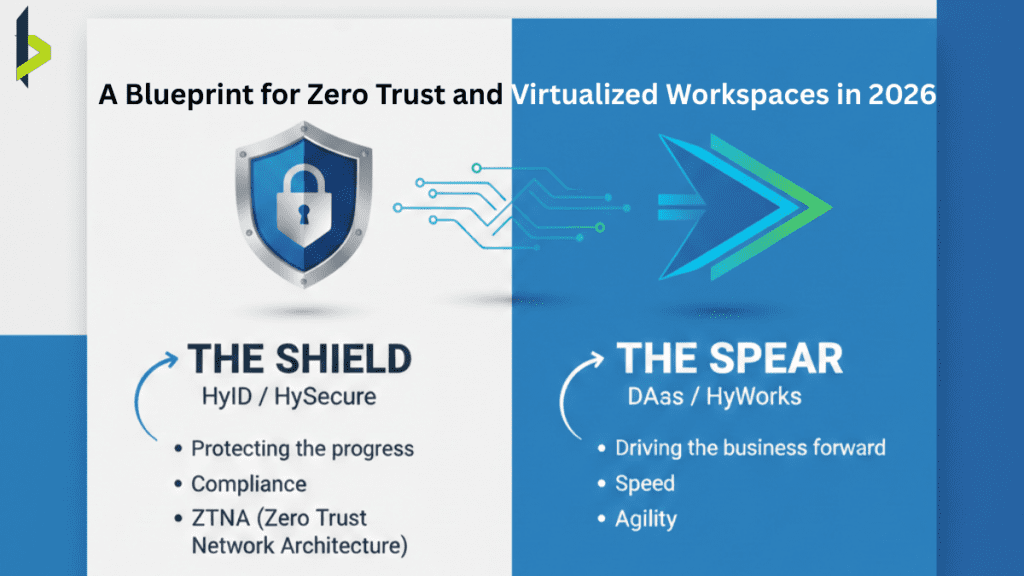
The answer lies not in incremental improvements to legacy VPN models, but in fundamental architectural shifts: Identity-First authentication, Zero Trust Network Access (ZTNA), and virtualized workspace delivery that keeps data sovereign while enabling access flexibility.
This article examines the blueprint Saudi enterprises are adopting to navigate this convergence—securing the digital frontier while maintaining compliance dividends that satisfy regulators and reduce operational risk.
Identity First – The Foundation of Modern Access Control
The Credential Theft Problem
Traditional access models rely heavily on username-password authentication, often supplemented by VPN connections that grant broad network access once credentials are validated. This approach creates systemic vulnerability: compromised credentials become keys to organizational infrastructure.
Saudi enterprises face sophisticated threat actors—from nation-state groups targeting critical infrastructure to financially motivated ransomware operations. Credential phishing, credential stuffing attacks using leaked password databases, and social engineering campaigns specifically target the weakest link in most security chains: static passwords.
The business impact extends beyond security incidents. SAMA’s Technology Risk Management Framework explicitly requires strong authentication controls for systems handling financial data. NCA’s ECC-1 (Cybersecurity Governance) and ECC-3 (Access Control) mandate multi-factor authentication for privileged access and remote connections. Organizations relying solely on passwords cannot demonstrate compliance.
How Identity Management Satisfies SAMA and NCA Requirements
Modern identity platforms like HyID address these gaps through layered authentication and centralized access governance:
Multi-Factor Authentication (MFA): Every access attempt requires validation beyond passwords—biometrics, hardware tokens, time-based one-time passwords, or push notifications to registered devices. This prevents credential theft attacks from succeeding even when passwords are compromised.
Single Sign-On (SSO): Rather than managing dozens of application-specific credentials (each representing potential exposure), users authenticate once through the identity platform. All subsequent application access is brokered through the identity layer, which enforces consistent policies and maintains comprehensive audit trails.
Context-Aware Access Policies: Authentication decisions consider not just credentials but device posture, location, time of access, and risk signals. An executive accessing financial systems from a managed device during business hours might authenticate seamlessly. The same user accessing the same system from an unrecognized device at 3 AM triggers step-up authentication or access denial.
Centralized Audit and Compliance Reporting: Every authentication event, access grant, and policy exception is logged. This creates the audit trail SAMA examiners expect during Technology Risk assessments and enables rapid incident investigation when security events occur.
The SAMA Compliance Dividend
SAMA’s Technology Risk Management Framework requires financial institutions to:
- Implement strong authentication for remote access and privileged accounts
- Maintain comprehensive access logs
- Enforce least-privilege principles
- Demonstrate regular access reviews
Identity platforms specifically designed for enterprise environments—like HyID—make these requirements operationally manageable rather than audit-time scrambles. Centralized identity governance means access policies are enforced consistently across applications, audit trails are automatically maintained, and compliance reporting becomes systematic rather than manual.
For Saudi enterprises in regulated sectors, this represents more than security improvement—it’s infrastructure that inherently supports regulatory alignment.
The New Perimeter – From VPN to Zero Trust Network Access
Why Traditional VPN Models Create Risk
VPN-centric remote access operates on a simple premise: authenticate the user, encrypt the tunnel, grant network access. Once connected, users typically gain broad access to internal network segments—effectively placing remote endpoints “inside” the corporate network.
This model creates three critical problems for Saudi enterprises:
1. Lateral Movement Risk: Compromised endpoints connected via VPN can pivot to other network segments, escalate privileges, and access systems beyond what the user legitimately requires. Ransomware incidents often exploit this—initial compromise of a single remote user becomes network-wide encryption because VPN access granted lateral movement capability.
2. Limited Visibility: VPN logs show connection events but provide minimal insight into what resources users actually access, what data they transfer, or whether their session behavior indicates compromise. This visibility gap complicates incident investigation and makes anomaly detection nearly impossible.
3. Compliance Limitations: NCA ECC-5 (Network Security) emphasizes network segmentation and least-privilege access. PDPL requires organizations to demonstrate control over data access and movement. VPN models that grant broad network access struggle to satisfy these requirements because access granularity is coarse—you’re either “on the network” or not.
How Zero Trust Network Access (ZTNA) Fundamentally Differs
Solutions like HySecure implement Zero Trust principles that invert the VPN model:
Application-Level Access, Not Network Access: Users authenticate to specific applications, not to network segments. An HR manager accesses the HRIS system but has no visibility into—much less access to—financial applications, development environments, or industrial control systems. This eliminates lateral movement because there’s no “network” to move laterally across.
Continuous Verification: Rather than granting access once at connection time, Zero Trust architectures continuously validate session legitimacy. Device posture is rechecked, user behavior is analyzed, and access can be revoked mid-session if risk signals indicate compromise.
Microsegmentation by Default: Every application becomes its own isolated segment. Compromise of one endpoint or credential set affects only the specific application that endpoint was authorized to access—not the entire internal network.
Comprehensive Session Logging: Because access is brokered through the ZTNA platform rather than direct network connections, detailed session logs capture what applications were accessed, what data was transferred, and what actions were performed. This visibility supports both security monitoring and compliance audit requirements.
The NCA Compliance Advantage
NCA’s Essential Cybersecurity Controls specifically require:
- Network segmentation to contain security incidents (ECC-5)
- Least-privilege access models (ECC-3)
- Comprehensive logging and monitoring (ECC-13)
Zero Trust architectures like HySecure make these requirements inherent to the access model rather than additional controls layered on top. Segmentation happens at the application level automatically. Least privilege is enforced because users access only explicitly authorized applications. Logging is comprehensive because all access is brokered and mediated.
For Saudi enterprises facing NCA compliance assessments, this represents architectural alignment with regulatory expectations rather than point-solution compliance.
Data Sovereignty – Keeping Sensitive Information in the Kingdom
The Remote Access Data Problem
When employees access applications remotely via VPN or direct cloud connections, data typically flows to their endpoints—laptops, tablets, personal devices. Files are downloaded, documents are cached locally, presentations are saved for offline work.
This creates three problems for Saudi organizations:
1. Data Residency Uncertainty: Once data reaches remote endpoints, organizations lose visibility and control. Is it stored on devices that leave the Kingdom? Is it synced to personal cloud accounts? Is it accessible after the employee separates from the organization?
2. PDPL Compliance Risk: The Personal Data Protection Law requires organizations to protect personal data “regardless of where it is processed.” But if personal data resides on unmanaged endpoints across multiple jurisdictions, demonstrating adequate protection becomes nearly impossible.
3. Incident Response Gaps: When security incidents occur, organizations need to identify what data was exposed and contain spread quickly. If data has proliferated to dozens or hundreds of remote endpoints, containment becomes a coordination nightmare.
How Virtual Desktop Infrastructure (VDI) Maintains Data Sovereignty
Solutions like HyWorks and Accops Desktop as a Service (DaaS) fundamentally change where data resides:
Data Remains in Kingdom Data Centers: Users access virtual desktops hosted in Saudi-based infrastructure. Applications run on these virtual machines, files are stored in centralized repositories, and processing occurs within Kingdom borders. Remote devices become display terminals—receiving screen updates and sending keyboard/mouse inputs, but never receiving actual data files.
No Local Data Persistence: Because data never travels to endpoints, there’s no local storage, no cached files, no offline copies on personal devices. When users disconnect, data remains in the data center—not scattered across devices in various locations.
Centralized Data Protection: Backup, encryption, access controls, and data loss prevention policies are enforced centrally rather than requiring endpoint-by-endpoint management. This dramatically simplifies PDPL compliance because data protection controls are implemented once, in controlled data center environments, rather than distributed across heterogeneous endpoints.
Simplified Incident Response: If a security event occurs, containment is straightforward—disable the compromised virtual desktop, investigate within the controlled environment, and restore from known-good backups. There’s no need to remotely wipe scattered endpoints or chase down where data might have traveled.
The PDPL Compliance Framework
PDPL Article 18 requires organizations to implement “appropriate technical and organizational measures” to protect personal data. The law also emphasizes data minimization and security by design.
Virtual desktop architectures align with these principles:
- Technical measures (encryption, access controls, audit logging) are implemented centrally and consistently
- Organizational measures (access policies, data classification, retention rules) are enforced through infrastructure rather than user compliance
- Data minimization occurs naturally—data doesn’t replicate to endpoints unnecessarily
- Security by design is architectural—data sovereignty is inherent to the VDI model, not an add-on control
For Saudi enterprises handling personal data—financial institutions managing customer information, healthcare providers handling medical records, government contractors processing citizen data—this represents infrastructure-level compliance rather than policy-dependent compliance.
The Mobile Workforce – Securing “Pocket Offices”
The BYOD Challenge
Saudi Arabia’s young, tech-savvy workforce increasingly expects to work from personal devices. Executives access emails from tablets during travel. Managers review dashboards from smartphones between meetings. Employees collaborate on documents from personal laptops at home.
This “Bring Your Own Device” (BYOD) reality creates security and compliance challenges:
Unmanaged Configurations: Personal devices often lack current patches, run unapproved applications, and have security settings optimized for convenience rather than protection.
Unclear Data Boundaries: When corporate data is accessed from personal devices, it intermingles with personal information, family photos, entertainment apps, and potentially malicious software downloaded from unverified sources.
Separation Risk: When employees leave the organization, corporate data often remains on their personal devices—creating data retention violations and potential intellectual property exposure.
How Mobile Device Management (MDM) Creates Separation
Modern MDM platforms address BYOD challenges through containerization and policy enforcement:
Corporate Containers: Rather than managing entire personal devices, MDM creates secure containers—isolated environments on the device where corporate applications and data reside. Users access corporate email, collaboration tools, and business applications within the container. Personal apps and data exist outside the container, maintaining privacy separation.
Policy Enforcement: Organizations define security baselines—minimum OS versions, encryption requirements, prohibited applications—and MDM enforces these within corporate containers. Devices that don’t meet baselines cannot access corporate resources.
Remote Management: If devices are lost, stolen, or associated with separated employees, IT can remotely wipe corporate containers without touching personal data. This satisfies data retention requirements while respecting employee privacy.
Compliance Visibility: MDM provides centralized reporting on device compliance status, application usage, and security posture—enabling organizations to demonstrate governance over mobile access during NCA or SAMA assessments.
The Executive Risk Consideration
Senior leaders often represent the highest-risk mobile users—accessing the most sensitive information from multiple devices while frequently traveling and sometimes resistant to security restrictions that impact convenience.
MDM platforms enable risk-proportional controls: executives might receive corporate-owned devices with full management, or BYOD access might be limited to less-sensitive applications with stricter containerization. The key is visibility and policy enforcement rather than hoping executives voluntarily maintain security discipline on personal devices.
Practical Application: How a Riyadh-Based Bank Addresses SAMA’s Cybersecurity Framework
Let me walk through how these concepts work in practice, using a scenario many of you are probably facing.
Consider a mid-sized Saudi bank headquartered in Riyadh. They’ve been operating with traditional VPN access for relationship managers, branch staff working remotely, and executives traveling frequently. The setup worked adequately for years—until SAMA’s updated Cybersecurity Framework landed with its enhanced requirements around access controls, data protection, and audit capabilities.
The compliance team flagged several gaps during their gap analysis. First, the VPN model granted network-level access—relationship managers connecting from home could theoretically access treasury systems, not just the CRM they actually needed. SAMA’s Principle 3.2 (Least Privilege Access) wasn’t being satisfied architecturally; it relied on hoping people didn’t abuse broad network permissions.
Second, customer data was being downloaded to endpoints regularly. Relationship managers saved client portfolios locally to review during meetings. Branch staff cached transaction reports on personal laptops to work offline. The bank couldn’t definitively answer where customer personal data resided at any given time—a problem for both PDPL Article 18 and SAMA’s Principle 4.1 (Data Classification and Protection).
Third, audit logging was fragmented. VPN logs showed connection times. Application logs showed some activity. But stitching together a complete picture of who accessed what customer data, when, and from where required manual correlation across multiple systems—making both routine audits and incident investigations time-consuming.
Here’s how the integrated Zero Trust approach addressed each gap:
For least privilege: The bank implemented HySecure ZTNA so relationship managers authenticate to specific applications—CRM, portfolio management tools, approved collaboration platforms—with no broader network visibility. Treasury systems, core banking platforms, and internal development environments are simply not accessible from remote connections unless explicitly authorized for specific roles. Principle 3.2 compliance became architectural rather than policy-dependent.
For data sovereignty: Customer-facing staff now access virtual desktops through HyWorks VDI hosted in the bank’s Riyadh data center. Client information never downloads to endpoints. Relationship managers see customer portfolios, but the data remains in controlled infrastructure. Branch staff review reports through virtual sessions that disconnect when work concludes—leaving no local traces. This satisfies PDPL Article 18’s protection requirements and SAMA Principle 4.1’s data classification controls without depending on individual user compliance.
For audit capability: Because all access flows through the integrated platform—authentication via HyID, application access via HySecure, data interaction within HyWorks sessions—unified logging captures the complete chain. SAMA examiners can see which user accessed which customer records, from what device type, at what time, and what actions they performed. Incident response improved significantly; when a phishing attempt compromised one user’s credentials, the security team could immediately see what systems that user had accessed and verify no data exfiltration occurred—all from centralized logs rather than manual correlation.
The bank’s CISO mentioned something during their implementation debrief that stuck with me: “We thought we were solving a compliance problem. What we actually got was operational clarity we didn’t know we were missing.” Audit preparation time dropped from weeks to days. Security investigations that used to take multiple analysts several days now conclude in hours. And when SAMA examiners arrived for their Technology Risk assessment, the compliance evidence was systematic rather than assembled frantically.
I share this not as a prescription—every organization’s context differs—but because it illustrates how integrated Zero Trust architectures solve multiple SAMA Framework requirements simultaneously rather than requiring separate point solutions for each principle. The compliance dividend compounds when security architecture and regulatory requirements align naturally.
Comparison: Legacy Remote Access vs. Modern Zero Trust Workspaces
| Dimension | Legacy VPN Model | Zero Trust Workspace (Accops Stack) |
|---|---|---|
| Access Granularity | Network-level (broad access once connected) | Application-level (specific apps only) |
| Data Location | Downloads to endpoints, unclear residency | Remains in Saudi data centers (VDI/DaaS) |
| Lateral Movement | High risk—compromised endpoint can pivot across network | Eliminated—no network access, only app access |
| PDPL Compliance | Difficult—data scattered across endpoints | Inherent—data never leaves controlled environments |
| NCA ECC Alignment | Requires additional controls for segmentation, least privilege | Architecturally aligned—segmentation and least privilege built-in |
| SAMA Framework | Manual evidence gathering, fragmented logs | Systematic compliance, unified audit trails |
| Visibility | Connection logs only, minimal session detail | Comprehensive—application access, data transfer, user behavior |
| Device Management | Limited or absent | Integrated MDM for BYOD and corporate devices |
| Incident Response | Complex—data potentially on many endpoints | Simplified—data centralized, containment straightforward |
| Authentication | Often password-based or weak MFA | Identity-first with strong MFA (HyID) |
| Audit Trail | Fragmented across systems | Unified logging across identity, access, and data layers |
Conclusion: The Integrated Stack Advantage – Compliance Dividend for Saudi Firms
Saudi enterprises navigating the convergence of digital transformation, regulatory requirements, and sophisticated threats face a strategic choice: continue layering point solutions onto legacy architectures, or adopt integrated platforms that make security and compliance inherent rather than additive.
The Accops integrated stack—combining HyID identity management, HySecure Zero Trust access, HyWorks VDI, and DaaS delivery—represents the latter approach. Rather than separate vendors for authentication, network access, virtual desktops, and mobile management, organizations deploy a unified platform where:
Identity governs all access through HyID’s MFA and SSO, satisfying SAMA authentication requirements
Zero Trust prevents lateral movement via HySecure’s application-level access, aligning with NCA segmentation mandates
Data remains sovereign through HyWorks and DaaS virtual desktop delivery, enabling PDPL compliance by design
Mobile devices are secured without invading privacy, balancing workforce flexibility with governance requirements
This integration creates what we call the “Compliance Dividend”—infrastructure that simultaneously enables business agility and reduces regulatory risk. Audit preparation becomes systematic rather than frantic. Incident response is contained rather than chaotic. Remote work is governed rather than hoped-for.
For Saudi CIOs and CISOs balancing Vision 2030’s ambitions with NCA, SAMA, and PDPL realities, the question isn’t whether to modernize remote access architecture—it’s whether to do so with integrated platforms that compound compliance advantages, or continue managing fragmented point solutions that create gaps adversaries and auditors will eventually exploit.
The digital frontier requires modern fortifications. Zero Trust workspaces provide the blueprint.
If you’ve recently gone through a SAMA Technology Risk assessment or NCA compliance review, what gaps did examiners focus on most—access controls, data residency, logging and monitoring, or something else entirely? How are you addressing those findings?