
Patch Management: The Silent Security Gap in Saudi Arabian Enterprises

Why do cyber attackers love unpatched systems? Because they’re an open door to your business data. This blog explains why patch management is critical for Saudi businesses—without the technical jargon.
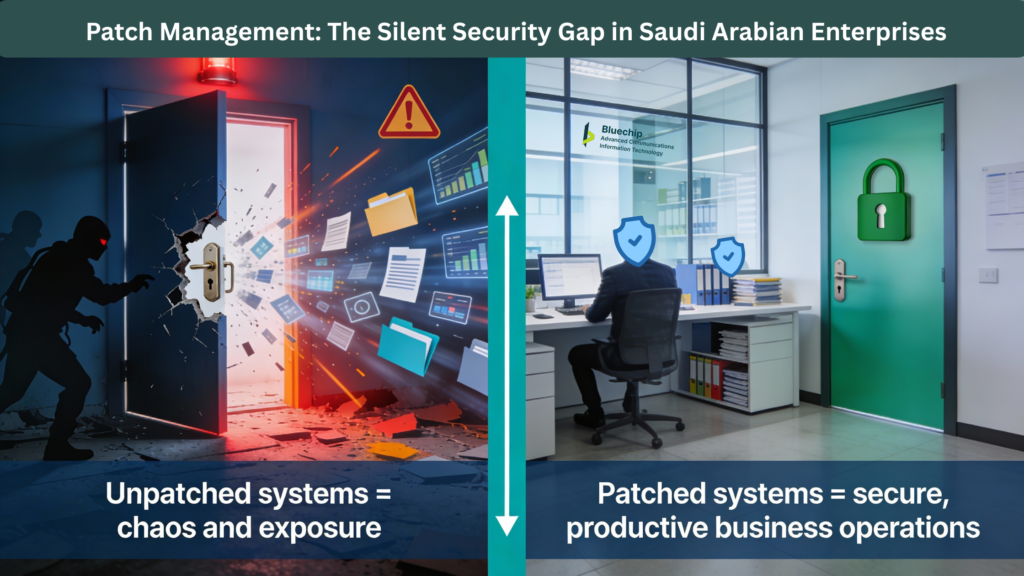
The Reality Check: Unpatched vs. Protected Systems
Unpatched Systems (The Risk)
When your systems aren’t regularly updated:
- Security vulnerabilities stay open and exposed
- Software updates fail, causing systems to crash
- Attackers find weaknesses and exploit them
- You can’t prove regulatory compliance to auditors
- One successful attack could compromise your entire operation
The bottom line: Unpatched systems are a silent crisis waiting to happen.
Protected Systems (The Solution)
When you implement regular patching:
- Security gaps get sealed before attackers find them
- Updates happen smoothly with proper testing
- You have documented proof of security measures
- Your business runs without unexpected interruptions
- You can confidently show regulators you take security seriously
The bottom line: Regular patching transforms security from a weakness into a strength.
Why Saudi Businesses Can’t Afford to Ignore This
1. You’re Operating Under Strict Regulations
Saudi Arabia has established cybersecurity and data protection laws that require organizations to maintain reasonable security measures. Having unpatched systems makes you vulnerable to regulatory scrutiny and potential penalties.
2. Government and Public Sector Expectations
If you work with government agencies or the public sector, they expect you to follow security standards. Regular patching is a basic requirement they look for during audits.
3. Mobile Threats Are Increasing
More employees work remotely and use mobile devices. Attackers specifically target unpatched mobile systems to gain access to company networks. This is becoming one of the top security risks for Saudi enterprises.
4. Your Business Depends on Continuous Operations
Whether you’re in finance, healthcare, energy, or any critical sector—downtime is expensive. Unpatched systems fail more often and create unexpected disruptions that cost your business in ways beyond just security.
Patch Management Explained Simply
| Manual Approach | Managed Approach |
|---|---|
| Updates happen randomly or when IT remembers | Updates happen on a regular schedule |
| Many updates fail or cause problems | Updates are tested before deployment |
| No way to undo failed updates | Changes can be reversed if needed |
| No records proving security measures | Complete documentation for compliance |
| IT team constantly firefighting | IT team focuses on strategy |
The Blue Chip Saudi Approach to Patch Management
We make this simple by breaking it into three phases:
Phase 1: Understand Your Risk
We assess your systems to identify which vulnerabilities matter most and need priority attention.
Phase 2: Deploy Updates Safely
We implement updates in a controlled way, testing them first to ensure nothing breaks. If something goes wrong, we can quickly fix it.
Phase 3: Monitor Continuously
We keep watch over your systems to ensure everything stays protected and you have records for compliance.
Real Business Impact: A Case Study
A Saudi Financial Services Company’s Story
Before:
Hundreds of unpatched vulnerabilities across systems
Updates had been delayed for months
Multiple security incidents occurred
Failed compliance audits
After Implementing Managed Patching:
Vulnerabilities systematically addressed
Updates deployed on a consistent schedule
No major security incidents
Passed compliance audits with full documentation
This transformation shows what’s possible when patching becomes systematic rather than reactive.
7 Common Patch Management Mistakes
Mistake #1: Treating All Updates the Same
Not all patches are equally urgent. A critical security update needs faster attention than a minor feature update.
Solution: Prioritize patches based on actual risk and impact.
Mistake #2: Manual Testing Takes Too Long
Your IT team manually tests each update individually, which slows everything down.
Solution: Use automated testing that is faster, repeatable, and more consistent.
Mistake #3: You Only Patch Servers
Attackers exploit unpatched printers, routers, phones, and applications just as easily.
Solution: Apply a comprehensive patching strategy across all connected devices.
Mistake #4: No Way to Reverse Failed Updates
When an update breaks a system, there is no quick recovery path.
Solution: Implement rollback capabilities to quickly revert failed changes.
Mistake #5: Updates Only Happen During Business Hours
This causes unnecessary disruption to daily operations and users.
Solution: Schedule updates during low-activity periods or deploy in controlled phases.
Mistake #6: No Documentation of What You’ve Done
When auditors ask for proof, there is nothing to show.
Solution: Maintain complete documentation of patching actions and security controls.
Mistake #7: Treating Patching as a One-Time Project
Patching is handled once and then forgotten, leaving systems exposed over time.
Solution: Establish patch management as an ongoing operational process.
Your Patch Management Checklist
Week 1: Get Started
Make a list of all your software and systems
Identify which updates are currently outstanding
Create a plan for addressing urgent issues first
Ongoing: Monthly Practice
Review what updates are available
Decide which ones matter most for your business
Test them in a safe environment first
Deploy with proper planning
Document what you’ve done
For Compliance: Maintain Records
Keep records of all updates deployed
Document any security measures taken
Create reports you can show auditors
Maintain timeline of your security efforts
Why Choose Blue Chip Saudi
We specialize in making security simple:
✅ We understand Saudi regulations – We know what PDPL and NCA requirements mean for your business
✅ We handle the complexity – You don’t need to become a security expert; we manage the technical details
✅ We document everything – Compliance audits become easier because we maintain proper records
✅ We prevent disruption – Updates happen in a way that doesn’t interrupt your operations
✅ We support your entire infrastructure – Whether it’s servers, computers, phones, or cloud services, we cover it all
What Happens Next: Your Action Plan
Step 1: Let’s understand your current situation
Have a conversation about your systems and concerns. No pressure, just information gathering.
Step 2: We create a customized plan
Based on your business, we recommend an approach that fits your needs and budget.
Step 3: We implement and manage it
You get the protection without needing new IT staff or specialized skills.
Step 4: You gain peace of mind
Your systems stay protected, you pass audits, and you can focus on growing your business.
Bottom Line
Patching isn’t optional. It’s fundamental.
Unpatched systems are like leaving your office doors unlocked at night. The damage happens silently, and by the time you notice, the harm is already done.
Regular patching isn’t complicated, expensive, or disruptive when it’s done right. It’s simply smart business practice.
See our social media comparison showed outdated systems vs. regularly patched systems
Ready to Secure Your Enterprise?
Let’s talk about what protection looks like for your organization.
Schedule a consultation with Bluechip-Saudi.
Schedule a Consultation