
Beyond Break-Fix: Why Managed IT Services Are the Backbone of Saudi Arabia’s 2026 Digital Transformation

Enterprise IT Intelligence · Riyadh, Saudi Arabia · 2026
| Direct Answer: Managed IT Services in Saudi Arabia refers to the practice of outsourcing day-to-day IT management, monitoring, and support to a dedicated external provider — replacing or augmenting in-house IT teams with a structured, service-level-backed model. In 2026, as Saudi enterprises accelerate digital transformation under Vision 2030, the shift from reactive break-fix IT support to proactive Managed IT Services is no longer a cost-optimisation decision. It is a strategic necessity for organisations that need to scale their digital capability faster than they can build internal IT expertise. |
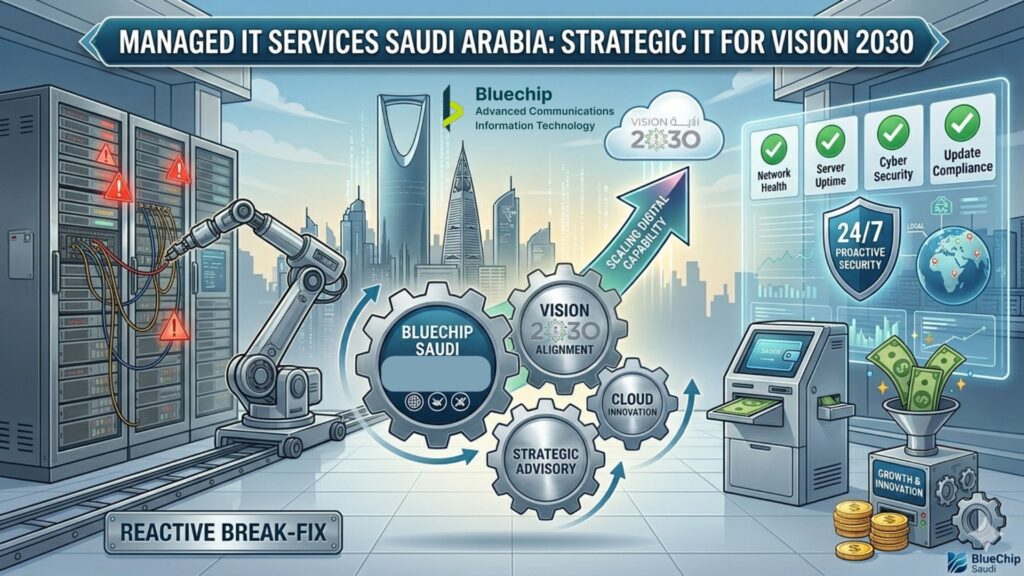
The Break-Fix Model and Why It Is Failing Saudi Enterprises
Break-fix IT — the model where IT support is engaged reactively, when something breaks — was a serviceable approach for organisations with relatively stable, simple technology environments. In 2026 Saudi Arabia, no enterprise IT environment fits that description.
The digital transformation agenda driving KSA organisations has introduced cloud infrastructure, hybrid work technology, mobile device fleets, cybersecurity platforms, and SaaS application estates — each with its own management requirements, update cycles, and failure modes. Managing this environment reactively means that IT teams are perpetually in firefighting mode: responding to incidents, replacing failed components, and addressing backlogs that accumulate faster than they can be cleared.
The cost of this model is not just direct IT spend — it is the opportunity cost. Every hour a skilled IT professional spends on reactive support is an hour not spent on the projects that drive business value: new system integrations, security improvements, digital capability development, and the strategic work that Vision 2030 mandates demand.
What Managed IT Services Actually Deliver
Proactive Monitoring and Incident Prevention
A Managed IT Services provider maintains continuous, 24/7 monitoring of your IT infrastructure — servers, networks, endpoints, cloud services, and security systems. The purpose of this monitoring is not to know when something has failed; it is to identify the indicators that something is about to fail, and to intervene before the outage occurs. For a Jeddah logistics company where system downtime translates directly to shipment delays, or a Riyadh financial services firm where application availability is a regulatory expectation, the difference between a prevented outage and a managed response to a live outage is significant.
Defined Service Levels and Accountability
Managed IT Services operate against contractually defined Service Level Agreements (SLAs): guaranteed response times, resolution targets, availability commitments, and reporting obligations. This accountability structure — absent in most in-house IT arrangements — gives business leaders visibility into IT performance as a measurable operational metric, and gives IT providers a clear obligation to perform.
Security Operations as a Managed Capability
Cybersecurity in 2026 KSA is not a set-and-forget configuration exercise. It requires continuous monitoring of the threat landscape, regular assessment of security posture, patch management that keeps pace with vulnerability disclosure cycles, and incident response capability that is available when threats materialise — which is not always during business hours. A Managed IT Services provider with integrated security operations capability delivers this as a continuous service, rather than requiring organisations to staff and maintain a full-time security operations function internally.
IT Strategy and Digital Transformation Support
The most capable Managed IT Services relationships extend beyond operational management to strategic advisory. A provider that understands your business objectives — not just your infrastructure topology — can contribute meaningfully to technology roadmap decisions: which cloud migration strategy fits your risk profile, which security framework aligns with your sector obligations, how to structure your IT architecture to support the digital capabilities your organisation will need in three years. For Saudi organisations navigating the technology implications of Vision 2030 sector targets, this strategic dimension of a managed services relationship has genuine business value.
|
The organisations in KSA that are accelerating digital transformation most effectively are not the ones with the largest in-house IT departments. They are the ones with the most effective partnerships — combining internal strategic direction with external operational execution capability that scales on demand. |
The Four Questions Saudi IT Leaders Should Ask Before Choosing a Managed IT Provider
1. Where Are They Based, and Do They Understand the KSA Environment?
An IT provider based in a different country operates with a fundamental information deficit about your environment. The regulatory context of Saudi Arabia — including the National Cybersecurity Authority’s frameworks, the Personal Data Protection Law (PDPL), and sector-specific requirements from SAMA and other bodies — is not incidental context; it is central to how IT decisions should be made. (Formal compliance guidance should be sought from qualified legal advisers.) A provider with physical presence and operational experience in Riyadh understands what others have to approximate.
2. What Does Their 24/7 Support Model Actually Look Like?
’24/7 support’ is a phrase that covers a wide range of operational realities — from a fully staffed NOC with regional engineers to an out-of-hours answering service that logs tickets for next-day action. Ask specifically: who responds to a P1 incident at 2am on a Friday in KSA, and what is their physically achievable response time to your Riyadh facility? The answer distinguishes genuine 24/7 operational capability from a commercial commitment that does not survive contact with a real incident.
3. How Do They Handle Security, and Is It Integrated or Bolted On?
IT management and cybersecurity are not separate disciplines in 2026. Every IT management decision has security implications: patch cycles, access control, configuration management, cloud security posture. A managed IT provider whose security capability is a separate engagement from a different team — rather than integrated into the day-to-day operational model — is delivering a fragmented service that creates the gaps adversaries exploit.
4. What Is Their Track Record in Your Sector in KSA?
Enterprise IT requirements differ significantly by sector. A Riyadh financial institution, a Dammam petrochemical company, and a healthcare operator in Jeddah have different infrastructure profiles, different regulatory contexts, and different operational risk tolerances. A managed IT provider with demonstrated delivery experience in your sector brings pattern recognition that a generalist provider — however technically capable — cannot replicate.
BlueChip Saudi: Managed IT Services Built for the KSA Enterprise
BlueChip Saudi is the dedicated Saudi Arabia division of Bluechip Gulf — a regional IT leader with over two decades of enterprise technology delivery experience across the Gulf. Our Riyadh operations combine the scale and vendor relationships of a regional leader with the local presence, Arabic and English support capability, and KSA market knowledge that enterprise clients in Riyadh, Jeddah, and Dammam require.
Our Managed IT Services model is built on proactive monitoring, defined SLAs, integrated security operations, and strategic IT advisory — structured to support the digital transformation objectives of Saudi organisations across commercial, government, healthcare, energy, and financial services sectors.
We do not offer a generic managed services package. Every engagement begins with a structured IT audit — assessing your current infrastructure, identifying operational gaps and risk exposures, and designing a managed services model that fits your organisation’s specific requirements and growth trajectory.
Elevate Your IT from Reactive to Strategic.
Request your Free IT Audit from our Riyadh team — a structured assessment of your current environment with a clear improvement roadmap, at no cost and no obligation.
📋 Request a Free IT Audit
Global Content Disclaimer: Blog Content is for general information and thought-leadership purposes only, reflecting common technical industry practices and publicly reported regional trends as of 2026. BlueChip Saudi makes no specific governmental, regulatory, or compliance claims on behalf of any organisation. Readers are strongly advised to consult qualified technical experts for implementation decisions and to obtain formal legal and regulatory guidance from a reputed government-approved adviser appropriate to their sector and jurisdiction. References to NCA, PDPL, SAMA, and Vision 2030 are contextual and informational only.