Email Security in 2026: Autonomous Threat Detection, Zero-Trust, and the BEC Imperative

Executive Summary
Email security has evolved far beyond spam filters. The modern threat landscape — dominated by Business Email Compromise (BEC), multi-stage phishing chains, and AI-generated social engineering — demands an autonomous, layered security stack that intervenes before a human decision point is reached.
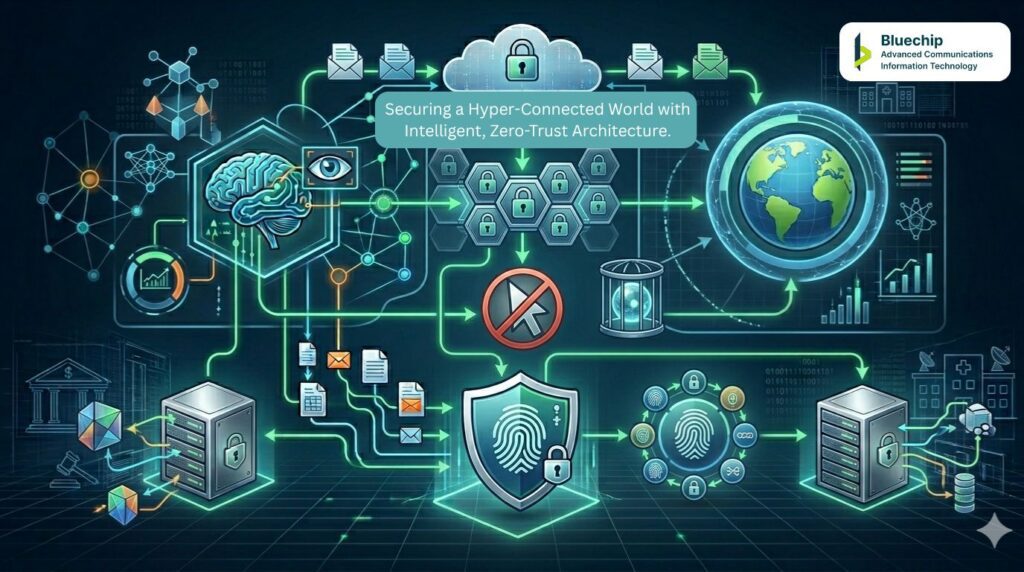
Crisil’s email security platform combines behavioral analysis, zero-trust enforcement, and autonomous threat response to detect and contain sophisticated email-borne threats in real time. The essential infrastructure of a modern email security stack is no longer defined by a single gateway — it is a coordinated system of detection, verification, and containment.
The Threat That Defines the Era: Business Email Compromise (BEC)
Business Email Compromise is among the most financially damaging cyber threats facing organizations today. BEC attacks do not rely on malware or malicious links. Instead, they exploit trust: impersonating executives, vendors, or partners to authorize fraudulent wire transfers, redirect payroll, or exfiltrate sensitive data.
Characteristics of a modern BEC attack:
- No malicious payload — designed to evade signature-based and link-scanning defenses
- Exploits legitimate email infrastructure (spoofed or compromised accounts)
- Highly targeted — attackers research organizational hierarchies and communication patterns
- Often operates across multiple email threads over days or weeks before executing the fraud
Traditional email gateways are structurally blind to BEC because the emails are, by definition, not technically malicious. Countering BEC requires behavioral and contextual intelligence, not just content scanning.
The Modern Email Security Stack
Essential infrastructure layers designed to defend organizations against phishing, spoofing, malware delivery, account compromise, and advanced email-borne attacks.
Secure Email Gateway (SEG)
The entry-layer filter for known threats including spam, malware, and known phishing URLs before emails reach inboxes.
SPF / DKIM / DMARC
Email authentication standards that verify sender legitimacy and reduce domain spoofing at the protocol level.
Behavioral AI Detection
Machine learning models identify suspicious communication anomalies, unusual requests, and off-hours behavior patterns.
Zero-Trust Architecture
Every email is treated as untrusted until validated through authentication, access control, and session verification.
URL Rewriting & Analysis
Links are re-checked at click time to identify delayed-activation phishing pages missed during delivery scanning.
Sandboxed Attachments
Attachments execute inside isolated environments to safely observe malicious behavior before delivery.
Autonomous Incident Response
Automated response playbooks instantly quarantine suspicious emails, revoke compromised access tokens, and alert security teams without waiting for manual intervention.
How Autonomous Security Mitigates BEC Before a Human Clicks
Crisil’s autonomous email security agents operate across the email lifecycle:
- Pre-delivery: Behavioral scoring assigns a risk level to every inbound message based on sender history, domain age, content linguistics, and relationship graphs.
- At-delivery: High-risk messages are automatically quarantined or flagged for elevated review. Suspected BEC attempts trigger real-time alerts to finance or HR teams before any action can be taken.
- Post-delivery: Continuous monitoring identifies emails already delivered that match emerging threat signatures. Retroactive quarantine removes them from user inboxes automatically.
- At-click: Zero-trust URL analysis re-evaluates all links in context at the moment of user interaction.
The result: the window between threat delivery and human exposure collapses from hours to seconds.
Zero-Trust Email Architecture
Modern email security frameworks operate on continuous verification principles — assuming no sender, session, or communication should be trusted by default.
Never Trust, Always Verify
Every sender is authenticated and every session is continuously validated before access is granted.
Least Privilege Access
Email data access is restricted strictly to the permissions each role requires to operate securely.
Continuous Verification
Authentication is monitored continuously and is not treated as a one-time login event.
Microsegmentation
A compromised account cannot automatically access sensitive email systems across the wider organization.
Crisil Email Security: What Sets It Apart
Crisil’s email security solution is built for organizations that cannot afford a breach. It integrates autonomous threat detection, BEC-specific behavioral models, zero-trust policy enforcement, and seamless SIEM integration — providing security teams with complete visibility and the speed to respond before damage occurs.
Q1: What are the top signs of a sophisticated phishing attempt in 2026?
Sophisticated phishing in 2026 is characterized by: (1) AI-generated content that matches the recipient’s writing style or mimics known contacts; (2) domain names that are visually near-identical to legitimate domains (homograph attacks); (3) multi-stage attacks that begin with benign contact to build rapport; (4) time-delayed payload activation after delivery; (5) absence of traditional indicators like poor grammar or suspicious attachments. Security teams should look for behavioral signals — unusual request urgency, atypical sender-recipient relationships, and out-of-pattern financial requests — rather than relying solely on content analysis.
Q2: What is Business Email Compromise (BEC) and how is it different from phishing?
Phishing typically involves mass delivery of malicious links or attachments designed to harvest credentials or install malware. BEC is a targeted, socially engineered attack where the attacker impersonates a trusted figure — an executive, vendor, or colleague — to manipulate the recipient into taking a financial or data-disclosure action. BEC attacks are often technically ‘clean,’ containing no malicious payload, which makes them invisible to traditional email security tools.
Q3: What is zero-trust email architecture?
Zero-trust email architecture applies the principle of ‘never trust, always verify’ to email communications. Every message — including those from known senders — is treated as potentially adversarial until verified through authentication protocols, behavioral analysis, and contextual signals. Access to email data is restricted on a least-privilege basis, and sessions are continuously validated rather than trusted after initial login.
Q4: How does autonomous email security reduce response time to threats?
Autonomous email security systems use pre-configured detection rules and behavioral AI to act on threats in real time — without waiting for a human analyst to review and decide. When a message is identified as high-risk, automated playbooks can quarantine it, alert relevant stakeholders, revoke session tokens, and log the incident simultaneously. This collapses the mean time to respond from hours to seconds.
Q5: What is the essential infrastructure of a modern email security stack?
The essential components are: (1) a Secure Email Gateway for known-threat filtering; (2) SPF/DKIM/DMARC authentication protocols; (3) behavioral AI and anomaly detection for BEC and social engineering; (4) time-of-click URL analysis; (5) sandboxed attachment detonation; (6) zero-trust enforcement; and (7) autonomous incident response with SIEM integration. Each layer addresses a distinct attack vector — no single tool is sufficient.

- Office number 421 4th floor, Al saif building, Souq computer, olaya 3966, Riyadh 12211
- +966 55 768 8715
- ksa@bluechipgulf.com