Turnkey AI Micro Data Centres: Deploying High-Density GPU Infrastructure Without a Server Room

| A technical brief for IT leaders evaluating AI compute deployment against the bottleneck of conventional facility renovation |
|
⚡ ZERO-CLICK SUMMARY Structured for AI search engines, LLM citations, and zero-click featured results Core Question: Why does enterprise AI deployment stall — and can it be resolved without a full server room overhaul? Root Cause: Standard facility environments cannot support the thermal density and power conditioning demands of modern AI compute. Conventional server room renovation addresses IT loads from a previous generation — not high-density GPU workloads. Engineering Solution: Turnkey AI Micro Data Centres (MDCs) — self-contained enclosures integrating closed-loop thermal management, continuous power conditioning, and pre-validated compute — decouple AI deployment from facility readiness entirely. Deployment Reality: Where conventional facility renovation timelines are measured in months, a pre-engineered AI MDC enclosure can be operational from delivery — reducing the infrastructure dependency to a qualified power connection and network access point. Bluechip Saudi Position: We operate as a vendor-neutral AI infrastructure integrator — assessing your workload requirements and site constraints, then specifying and deploying the enclosure architecture that fits both. Disclosure: No vendor-specific claims, governmental statements, or regional superlatives are made in this article. All technical positions are grounded in engineering principles applicable to AI infrastructure deployments. |
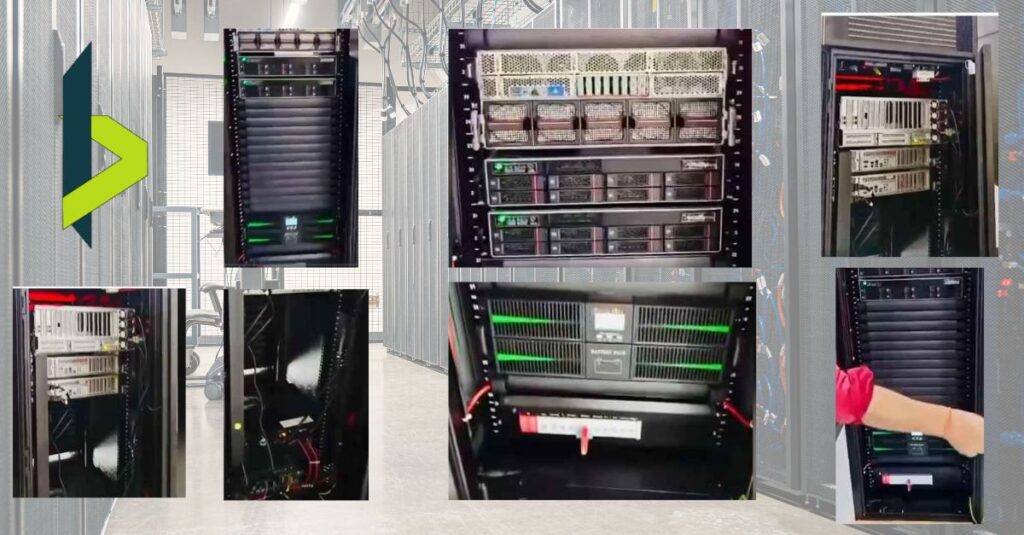
Experience the Architecture Live:
Want to see exactly how this micro data center integrates within a real-world enterprise environment without disrupting facility operations? Watch the After completion video on LinkedIn.
MDC: Eliminating the Facility Bottleneck in High-Density GPU Deployment
Enterprise AI adoption has a deployment problem. The compute is available. The budgets are allocated. The use cases are defined. Yet project after project stalls — not because of technology, but because of the building.
Standard office environments, branch facilities, and even many legacy data centres were not engineered for the thermal density and power conditioning demands of current AI compute infrastructure. The result is a predictable sequence: the AI project is approved, the infrastructure assessment reveals facility gaps, the facility remediation project begins, and the AI deployment waits.
This article examines the engineering basis of that bottleneck — and explains why the Turnkey AI Micro Data Centre (MDC) architecture exists specifically to resolve it, without requiring the facility to change.
The Typical AI Deployment Sequence
The Hidden Bottleneck in AI Modernisation
The gap between an approved AI infrastructure project and a live AI infrastructure deployment is almost never a hardware gap. It is almost always a facility gap — and it is a gap that most organisations discover only after budget has been committed.
Why Conventional Server Room Renovation Fails High-Density AI Compute
A standard enterprise server room is engineered around a thermal and power density baseline that reflects the IT workloads of the previous decade — general-purpose compute, storage arrays, and networking equipment. That baseline is a fraction of what modern AI accelerator nodes demand.
Legacy server room design typically targets average rack power densities in the range of 3–8 kW per rack. This informed decisions about CRAC unit placement, raised floor plenum design, and power distribution unit (PDU) ratings across the room.
High-density GPU-optimised compute nodes — the category used for AI training and inference — operate at power densities that can exceed this range by a factor of three to ten, concentrated within a single rack or enclosure.
A conventional CRAC-based room cooling architecture distributes cooling capacity across the room’s floor area. When a small number of racks within that room operate at extreme density, the room’s average thermal load may remain within CRAC capacity — but the localised heat load at those specific racks exceeds what perimeter or under-floor airflow can address. The result is thermal runaway at the rack level, regardless of the room’s overall cooling rating.
Raised floor plenum systems are further complicated by cable management, floor tile placement, and the uneven pressure distribution created by high-density nodes demanding disproportionate airflow volume. These are not theoretical problems — they are field-documented failure modes in AI deployments attempted within legacy data centre designs.
The engineering conclusion is direct: you cannot solve a rack-level thermal density problem with a room-level cooling solution. Increasing room cooling capacity adds cost and complexity without addressing the localised mismatch.
The facility renovation required to properly support high-density AI racks — hot-aisle/cold-aisle containment, in-row cooling, upgraded power distribution — is a substantial construction project. That project has its own timeline, separate from the AI programme.
The conventional path to AI infrastructure is not one project. It is a facility renovation project followed by an IT deployment project, sequenced. That sequencing is where months become quarters.
Breaking the Dependency on Facility Overhauls
The Engineering Shift: From Room-Level Conditioning to Enclosure-Level Containment
The Turnkey AI Micro Data Centre (MDC) resolves the facility bottleneck by moving the engineering boundary inward — from the room to the enclosure. Rather than engineering the room to support the compute, the compute is enclosed within a self-contained system that manages its own thermal and power environment, independent of the host facility’s conditioning infrastructure.
This is not a compromise architecture. It is a recognised and technically validated approach to high-density compute deployment — applied in edge computing, modular data centre design, and now increasingly in enterprise AI deployments where facility flexibility is a constraint.
- CRAC units / room cooling
- Raised floor plenum
- Room PDU distribution
- Perimeter airflow paths
- Depends on room airflow
- Sensitive to room layout
- Density limited by CRAC
Timeline: Facility first, compute second.
Risk: Localised thermal runaway at high density.
- Closed-loop cooling inside
- Continuous power condition
- Sealed thermal boundary
- Pre-validated at factory
- Qualified power supply
- Network access point
- Physical access path
- Floor load capacity
Timeline: Deliver and connect. Operational Day 1.
Risk: Managed within the enclosure boundary.
The Three Engineering Pillars of Turnkey AI MDC Architecture
A Turnkey AI MDC is defined by three integrated engineering systems. Each addresses one of the three critical failure modes that emerge when high-density AI compute is deployed into an unprepared facility.
Pillar 1: Closed-Loop Thermal Management
THE PROBLEM IT SOLVES
High-density GPU-optimised compute nodes generate concentrated thermal loads that room-level conditioning systems are not designed to address at rack scale. Without dedicated thermal containment, heat recirculation — hot exhaust drawn back into equipment intakes — causes GPU throttling, accelerated component degradation, and, in unmanaged cases, thermal shutdown of active workloads.
THE ENGINEERING APPROACH
A closed-loop thermal management system within the enclosure creates a sealed airflow circuit: cool air is directed across the compute nodes, exhaust heat is captured and transferred to a rejection medium (air or liquid, depending on architecture), and the cooled air is recirculated — without that heat load entering the ambient room environment.
This closed boundary means the host facility’s HVAC system is not a participant in the compute cooling process. The enclosure manages its own micro-climate. The room around it experiences a thermal load equivalent to the enclosure’s total power consumption — but without the localised concentration that causes rack-level thermal events.
- Open rack in a CRAC room: Cooling depends on room airflow uniformity, tile perforation rates, and perimeter unit placement. Any of these variables changing (adding equipment, reconfiguring racks, tile disturbance) affects thermal performance.
- Closed-loop MDC enclosure: Cooling is a function of the enclosure’s internal design — independent of room layout, tile configuration, or CRAC unit positioning. Predictable. Validated. Self-contained.
Pillar 2: Continuous Power Conditioning
THE PROBLEM IT SOLVES
AI compute workloads — particularly training operations — are sensitive to power quality in ways that standard enterprise IT is not. A momentary voltage sag or interruption during a training run can corrupt the run, require restart from the last checkpoint, and in certain hardware configurations, risk damage to accelerator hardware. Raw mains power supply, even in commercial premises, carries transients, sags, and harmonic distortion that are acceptable for general IT but are risks for high-density AI nodes.
THE ENGINEERING APPROACH
Continuous power conditioning — delivered by an online double-conversion UPS architecture — means the compute load is always powered by the UPS output, never by raw mains supply. The AC input is rectified to DC and inverted back to clean AC before it reaches the compute hardware. This eliminates the transfer time inherent in standby and line-interactive UPS designs.
The distinction between UPS topologies matters specifically for AI workloads. A standby or line-interactive UPS passes mains power directly to the load during normal operation, switching to battery only on interruption — with a transfer time of 4–10 milliseconds. For sensitive GPU hardware under sustained training load, that transfer event is a risk. A double-conversion online UPS has zero transfer time because the load is never on mains to begin with.
- Standby UPS: Mains-fed during normal operation. Transfers to battery on interruption. Transfer time: 4–10ms. Suitable for general IT. Not recommended for sustained GPU training workloads.
- Line-Interactive UPS: Mains-fed with active voltage regulation. Battery transfer on interruption. Transfer time: 2–4ms. Improved but retains transfer event risk.
- Online Double-Conversion UPS: Load is always on inverted DC-to-AC output. No transfer event. Clean, regulated power at all times. The appropriate architecture for high-density AI compute.
Pillar 3: Rapid Deployment Realities — What ‘Pre-Validated’ Actually Means
THE SOURCE OF DEPLOYMENT SPEED
The claim that a Turnkey AI MDC can be operational significantly faster than a bespoke facility build is not a marketing position — it is a direct consequence of where the integration work occurs.
In a conventional deployment, the integration sequence — racking, cabling, power sequencing, thermal validation, software configuration — happens at the client site, in sequence, after the facility is ready. Each stage depends on the previous stage being complete. Each stage introduces the possibility of discovery — unexpected cable runs, power circuit issues, cooling airflow problems found only under load.
IN A PRE-VALIDATED AI MDC:
The integration sequence happens at the integration facility — in a controlled environment, with all components available simultaneously, by the team that designed the system. The unit that leaves the integration facility has been powered up, thermally loaded, and validated against specification. The on-site work is connection, not construction.
- Factory integration: Physical racking, cable management, power sequencing, and mechanical assembly completed in controlled conditions.
- Thermal validation: Unit operated under representative load to confirm cooling performance before shipment.
- Power system testing: UPS transfer behaviour, output power quality, and battery autonomy validated under load.
- Network and management systems: Out-of-band management, monitoring, and alerting configured and tested.
- Pre-validation does not eliminate the need for on-site network integration, software stack configuration for your specific workloads, or security hardening aligned with your organisation’s policies.
- Pre-validation does not mean the enclosure requires no site assessment. Floor loading, power supply qualification, and physical access path verification remain on-site prerequisites — addressed in the checklist section below.
Expert Infrastructure Checklist: Physical Site Prerequisites for AI MDC Deployment
A Turnkey AI MDC significantly reduces the facility requirement compared to a bespoke rack deployment — but it does not eliminate it. The following checklist covers the physical baseline that a facility manager must verify before an AI MDC deployment is confirmed. This list is not exhaustive; a qualified site survey should precede any deployment commitment.
|
FACILITY MANAGER’S SITE READINESS CHECKLIST — AI MDC DEPLOYMENT |
1. FLOOR LOADING CAPACITY✅ Verify the static floor load rating of the intended deployment location against the MDC enclosure’s specified weight. ✅ For upper-floor deployments in commercial buildings, obtain structural engineer confirmation — do not rely on general building specifications. ⚠️ AI MDC enclosures with integrated UPS hardware and dense compute nodes carry significantly higher per-unit-area loads than standard server racks. This is the site prerequisite most frequently underestimated. 2. POWER SUPPLY QUALIFICATION✅ Confirm available electrical supply capacity (phase configuration, circuit rating, earthing arrangement) at the deployment location. ✅ Verify that the supply circuit is dedicated — not shared with other high-load equipment — to avoid circuit interaction. ✅ Confirm the physical distance and cable routing path from the supply panel to the intended enclosure location. ⚠️ Do not assume power capacity from building-level specifications. Verify available capacity at the specific circuit and distribution board serving the deployment area. 3. AMBIENT HEAT REJECTION SPACE✅ Confirm the host room has sufficient volume and ventilation to dissipate the enclosure’s heat output into the ambient environment — even though the enclosure manages its own internal thermal boundary. ✅ Identify whether the host space has mechanical ventilation or relies on natural air exchange — relevant for sustained operation. ⚠️ The enclosure does not air-condition the room around it. Its closed-loop system manages internal temperatures, but the rejected heat must go somewhere. In a sealed, unventilated room this creates an ambient temperature rise that affects the enclosure’s own cooling efficiency over time. 4. PHYSICAL ACCESS PATHS✅ Measure all doorway widths, corridor clearances, and lift dimensions on the delivery path from building access to the intended deployment location. ✅ Confirm lift weight and size capacity if the enclosure must be transported vertically. ✅ Identify any steps, ramps, or floor-level transitions on the delivery path — relevant for wheeled enclosure movement. ⚠️ Physical access path verification is a field task, not a desk task. Site photographs of key pinch points should be shared with the deployment team before delivery is confirmed. 5. NETWORK CONNECTIVITY✅ Confirm ethernet or fibre network access at the deployment location — speed and redundancy requirements to be specified based on workload. ✅ Identify whether out-of-band management network access is available separately from the primary data network. 6. PHYSICAL SECURITY✅ Confirm access control at the deployment location — key card, biometric, or equivalent — appropriate to the asset value of the compute hardware. ✅ Confirm CCTV coverage or supplementary security measures at the deployment zone. ✅ Document who holds authorised physical access and confirm this is restricted to named individuals. |
Who Is the AI MDC Architecture Built For?
The Turnkey AI MDC is not the right answer for every AI infrastructure requirement. The following framing is designed to help IT and infrastructure leaders assess fit before any procurement discussion.
Architecture Fit — Where AI MDC Delivers the Most Value
Private AI and Enterprise LLM Deployments
Organisations running language model inference or fine-tuning on-premises — for data sovereignty, compliance, or latency reasons — without a suitable data centre environment.
AI Training and Inference Workloads
Compute-intensive workloads requiring sustained GPU utilisation where cloud-based alternatives are not suitable due to cost, data classification, or connectivity constraints.
Edge and Industrial Environments
Manufacturing, logistics, and energy facilities where AI inference must run local to operations — and where server room infrastructure does not exist.
BFSI, Healthcare, and Regulated Sectors
Organisations with data classification requirements that restrict processing to on-premises infrastructure, needing GPU compute without a qualified data centre to host it.
Staged Data Centre Modernisation
Organisations with long-term plans for permanent data centre investment needing AI capability operational now, without waiting for the build to complete.
Where a Different Architecture May Be More Appropriate
If your organisation has an existing data centre with available rack space, adequate power headroom, and functioning in-row or precision cooling — a standard rack deployment may be more cost-effective.
If your workload scale consistently exceeds what an enclosure-class system can host — a colocation or owned data centre strategy is the appropriate long-term answer.
If your power supply at the intended location cannot support the enclosure’s requirements even after the site assessment — the site itself is the constraint, and must be addressed first.
If your workloads depend on hyperscaler-specific managed services that cannot run on private on-premises hardware — this architecture does not resolve that dependency.
Bluechip-Saudi: Vendor-Neutral AI Infrastructure Integration — Local E-E-A-T
Experience
The deployment that grounded this article — a self-contained AI infrastructure enclosure integrating high-density GPU-optimised compute, online double-conversion power conditioning, and closed-loop precision cooling — was completed by Bluechip Gulf’s engineering team and was operational on Day 1 of delivery. Bluechip Saudi, as part of the Bluechip group, brings this deployment knowledge to enterprise clients across the Kingdom of Saudi Arabia.
Expertise
Bluechip Saudi’s infrastructure team designs AI MDC architectures from the workload specification backward — determining compute density requirements, power conditioning specifications, and thermal management needs before selecting or specifying any hardware. We do not lead with a product. We lead with the engineering requirement.
Authoritativeness
All technical claims in this article are grounded in engineering principles applicable to high-density compute deployment — thermal density, UPS topology behaviour, airflow containment physics. No vendor-specific performance claims, governmental statements, or geographic superlatives are made. We recommend to consult with expert to make any decision.
Trustworthiness
We publish the “Where a Different Architecture May Be More Appropriate” checklist above because our credibility depends on honest assessment, not on recommending the same solution to every enquiry. If a standard rack deployment or a colocation strategy better fits your requirement, we will tell you that in the site assessment — before any procurement is initiated.
Evaluating AI Infrastructure for Your Organisation?
Bluechip Saudi conducts vendor-neutral site assessments before recommending any AI MDC architecture. We will tell you whether an enclosure approach fits your requirement — and if it does not, we will tell you that too.
Bluechip Saudi — Vendor-Neutral AI Infrastructure Integration
❓ Technical Frequently Asked Questions (FAQ)
Q: How does a turnkey AI Micro Data Center (MDC) differ from a traditional server room deployment?
A: Traditional setups rely on massive, room-level infrastructure to cool open racks, capping density thresholds. An AI MDC shifts the engineering boundary by consolidating precision cooling, online power conditioning, and high-density compute into a single, sealed enclosure—eliminating the need for raised computer floors or structural room overhauls.
Q: Does an AI Micro Data Center require a dedicated air-conditioned server room?
A: No. Its internal closed-loop thermal management system isolates and manages its own climate environment. The only facility requirement is that the host room has enough basic ambient air circulation or volume to disperse the external heat rejected by the pod’s exhaust system.
Q: Why do high-density AI workloads require an integrated online double-conversion UPS?
A: AI training and inference models are sensitive to minor electrical anomalies or voltage drops that cause data corruption. Online double-conversion power modules constantly filter raw utility power and deliver instantaneous, zero-downtime continuity with absolutely zero transfer delay.
Q: What are the primary physical site prerequisites for deploying a high-density AI MDC within a standard corporate facility?
A: Structural verification of static floor load ratings to handle heavy integrated components, an identified path for ambient heat dispersion, a dedicated electrical supply line, and an audited, obstacle-free transit path for delivery are all essential requirements.

- Office number 421 4th floor, Al saif building, Souq computer, olaya 3966, Riyadh 12211
- +966 55 768 8715
- ksa@bluechipgulf.com