
The Shift to AI-Powered Cyber Threats in KSA: How to Build an Active Defence Strategy for 2026

BlueChip Saudi · Cybersecurity Intelligence · Riyadh, Saudi Arabia · 2026
|
Direct Answer: AI-powered cyber threats in Saudi Arabia are real, growing, and qualitatively different from the attacks that dominated the previous decade. In 2026, the threat landscape facing KSA enterprises — from Riyadh financial institutions to Dammam energy operators — is characterised by attacks that are faster, more adaptive, and harder to detect with conventional signature-based defences. The answer is an Active Defence strategy: a posture that combines AI-driven threat intelligence, continuous monitoring, and automated response to match attackers at machine speed. |
2026 Cybersecurity Snapshot for KSA:
-
The Threat: AI-driven phishing and adaptive malware moving at machine speed.
-
The Compliance: Mandatory alignment with NCA and PDPL standards for 2026.
-
The Solution: Shifting from reactive tools to an Active Defence posture.
Why 2026 Is the Inflection Point for Saudi Cybersecurity
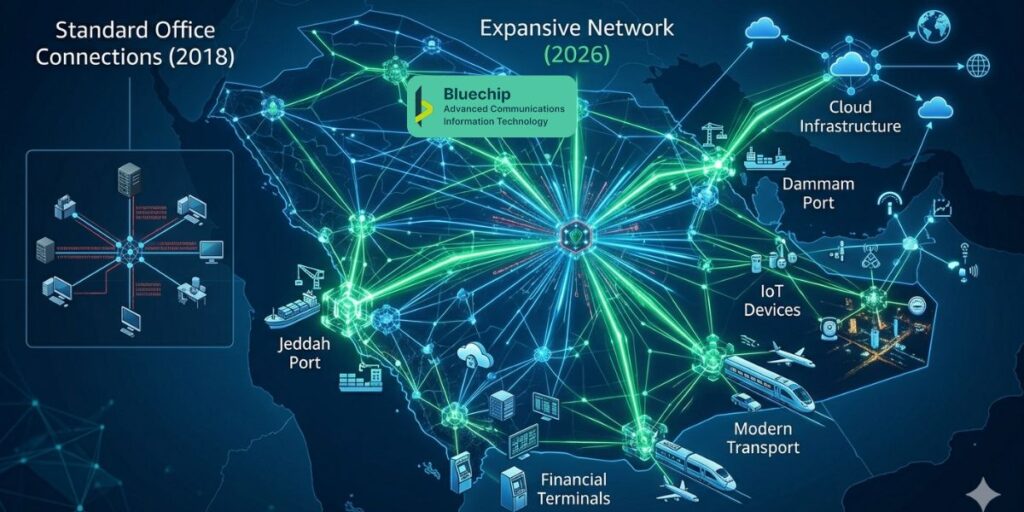
Saudi Arabia’s digital economy has grown significantly under the Vision 2030 framework. Cloud adoption has accelerated across both public and private sectors. Remote and hybrid working is now standard for enterprise organisations in Riyadh, Jeddah, and Dammam. Critical infrastructure modernisation — in energy, transport, finance, and healthcare — has expanded the nation’s digital attack surface to a scale that would have been unrecognisable five years ago.
At precisely the same moment, the tools available to threat actors have undergone their own transformation. Artificial intelligence — the same technology driving productivity gains across legitimate industry — is now embedded in the offensive toolkit of sophisticated adversaries. The result is a new category of cyber threat that demands a different category of defence.
What AI-Powered Cyber Threats Actually Look Like
1. AI-Generated Spear Phishing at Scale
Traditional phishing campaigns were detectable by their generic language, poor grammar, and implausible pretexts.
AI-generated phishing in 2026 is a categorically different problem. Large language models can synthesise publicly available information about a target — their role, organisation, recent activities, professional connections — and produce highly personalised, contextually credible messages that are indistinguishable from legitimate correspondence.
These attacks scale without the traditional constraint of requiring skilled human operators for each message.
2. Adaptive Malware That Evades Signature Detection
Conventional endpoint protection relies heavily on signature matching — identifying known malicious code patterns.
AI-enabled malware can now modify its own code structure in real time to evade these signatures, generating variants that have never been seen before and for which no signature exists.
Against this class of threat, signature-based detection is a necessary but insufficient control. Behavioural detection — monitoring what code does, rather than what it looks like — becomes the critical defensive layer.
3. Automated Vulnerability Discovery and Exploitation
The time between the public disclosure of a vulnerability and the appearance of active exploitation campaigns has compressed dramatically. AI-assisted scanning and exploitation tools allow attackers to identify vulnerable systems at a speed and scale that far exceeds any manual patching cycle. Organisations that manage vulnerability remediation reactively — waiting for weekly or monthly patch cycles — are operating with a systemic exposure window that 2026 threat actors are specifically designed to exploit.
4. AI-Driven Social Engineering and Deepfake Fraud
Sophisticated fraud campaigns targeting KSA financial institutions and corporate entities are increasingly leveraging synthetic media — convincing voice and video generation that impersonates executives, clients, or regulators. A CFO receiving an urgent payment instruction that appears to come from the CEO — complete with a voice that matches exactly — faces a social engineering attack that no amount of password policy will prevent. These attacks target the human layer of security with precision that was not operationally available to most threat actors before AI.
|
The defining characteristic of AI-powered threats is their speed. Traditional attack campaigns operated over days or weeks. AI-assisted attacks can move from initial compromise to lateral movement and exfiltration in hours. The implication is stark: defences that operate on human timescales cannot respond to attacks that operate on machine timescales. |
Building an Active Defence Strategy for KSA 2026
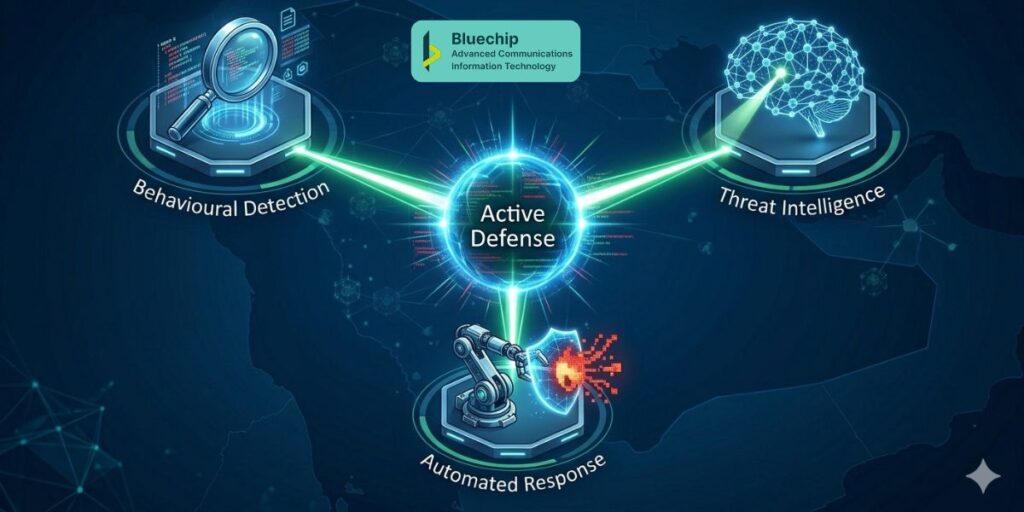
An Active Defence strategy is the deliberate shift from reactive incident response to proactive, continuous threat detection and disruption. It does not eliminate the need for perimeter security or endpoint protection — it adds the intelligence layer that makes those controls effective against adaptive threats.
Threat Intelligence Integration
Active Defence begins with knowing what threats are targeting your sector, your region, and your specific organisation.
Threat intelligence platforms aggregate and contextualise indicators of compromise, adversary tactics, and emerging attack patterns — enabling security teams to adjust defences ahead of attacks rather than in response to them.
BlueChip Saudi’s security practice incorporates threat intelligence capabilities that are specifically calibrated for the Middle East threat landscape, drawing on our position as the KSA division of Bluechip Gulf — a regional IT leader with visibility across enterprise security deployments across the Gulf.
Behavioural Detection and UEBA
User and Entity Behaviour Analytics (UEBA) establishes a baseline of normal behaviour for every user and system in the environment.
Deviations from that baseline — unusual login times, atypical data access patterns, unexpected lateral movement — trigger alerts regardless of whether the underlying activity matches any known attack signature. This is the defensive layer that catches the threats that signature detection misses.
Automated Response and Containment
Detecting a threat at machine speed is only valuable if the response capability matches. Security Orchestration, Automation, and Response (SOAR) platforms enable predefined response actions — isolating a compromised endpoint, blocking a suspicious account, quarantining a malicious file — to execute in seconds rather than requiring manual analyst intervention.
For high-velocity AI-driven attacks, automated containment is not an enhancement; it is a necessity.
Regular Adversarial Testing
An Active Defence posture requires validation. Red team exercises, penetration testing, and tabletop simulations against realistic AI-powered attack scenarios provide the empirical evidence that defences are performing as designed — and identify the gaps before an actual adversary does.
What This Means for KSA Organisations in Practical Terms
- Review your threat detection architecture: if it relies primarily on signature-based tools, identify where behavioural detection gaps exist.
- Assess your vulnerability management cycle: how long does it take from disclosure to patch, and is that timeline acceptable given current exploitation speeds?
- Evaluate your incident response plan against a tabletop scenario involving an AI-assisted attack — one that moves in hours, not days.
- Consider whether your security team has access to contextualised, regional threat intelligence, or whether they are relying on generic global feeds.
- Examine your employee security awareness programme: does it address AI-generated phishing and deepfake social engineering scenarios?
Conclusion: The Threat Has Evolved. The Defence Must Too.
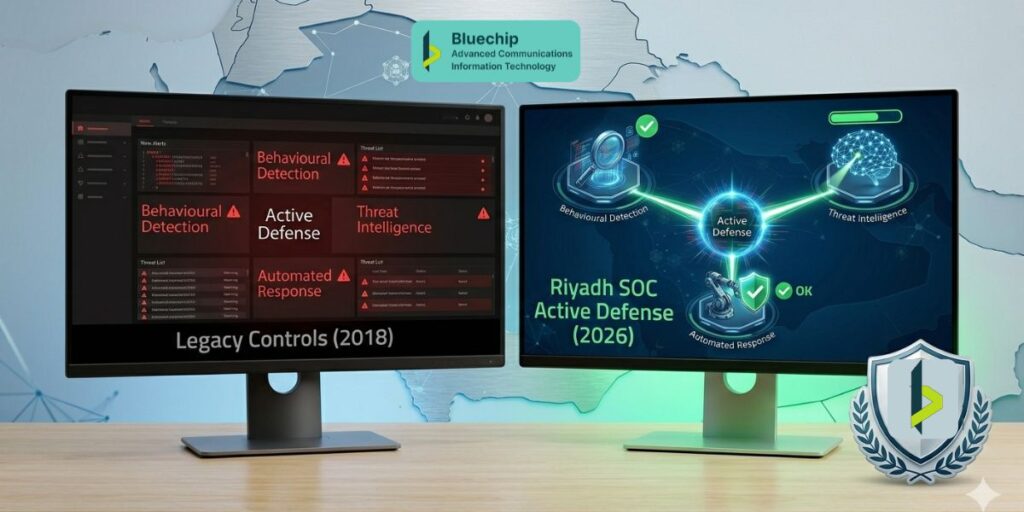
The organisations in Saudi Arabia that are most at risk in 2026 are not those with no cybersecurity controls — they are the organisations with legacy controls designed for the threats of 2018. The shift to AI-powered attacks is not a future development to plan for; it is a present reality to respond to.
BlueChip Saudi is the dedicated KSA division of Bluechip Gulf — combining regional scale with Riyadh-based expertise — helping enterprise organisations across the Kingdom assess their current security posture against the 2026 threat landscape and build the Active Defence capability that the environment demands.
|
Is Your Organisation Ready for AI-Powered Threats? Request a Free Security Posture Assessment from our Riyadh team. 📋 Request a Free IT Audit 📞 +966 55 768 8715 |